
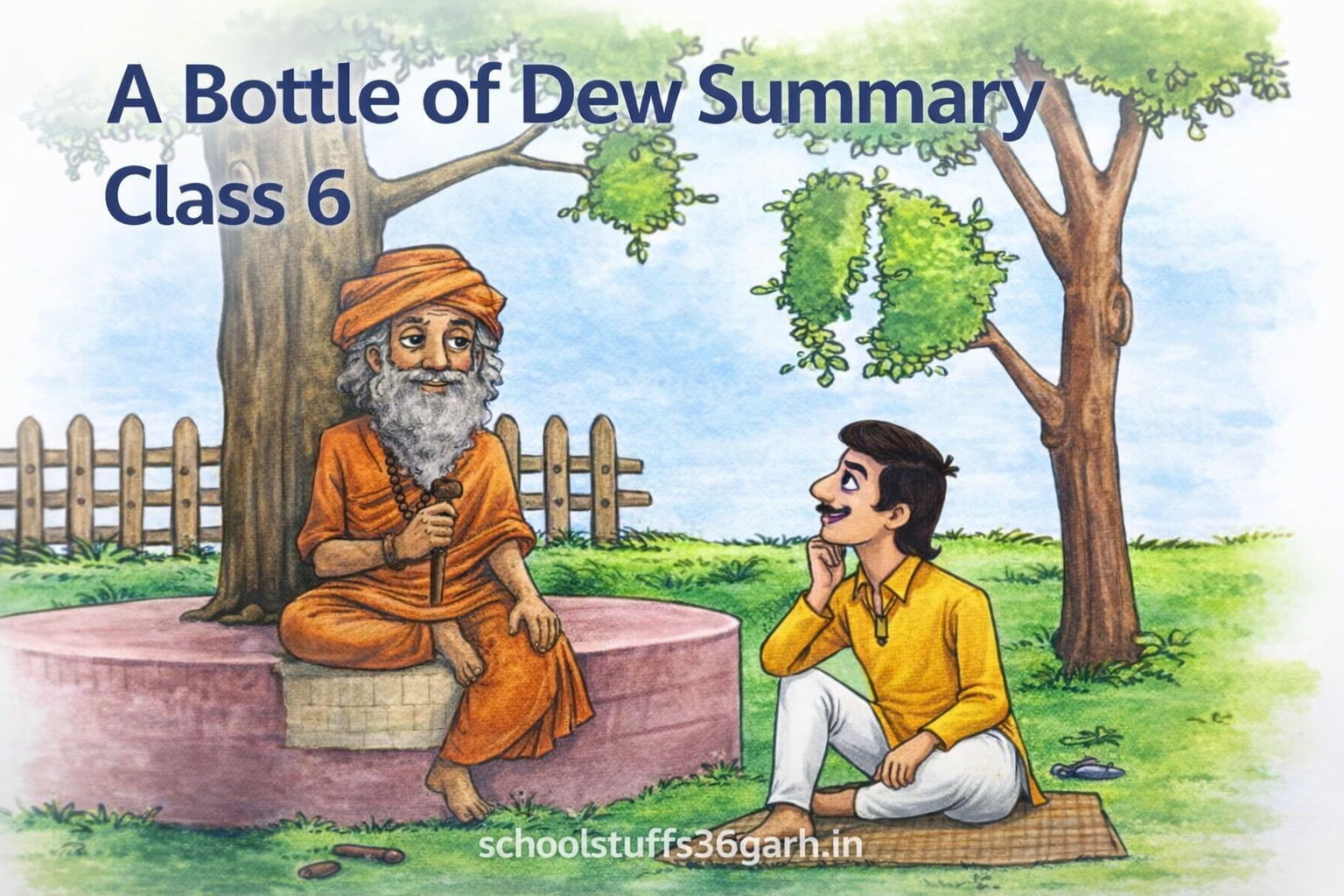
A Bottle of Dew Summary Class 6: Ultimate Guide (Poorvi English)
A Bottle of Dew summary class 6 is a student-friendly explanation of the folk tale from the Class 6 Poorvi English book. In this guide, you will get the complete story in simple words, key characters, moral, themes, exam-style questions, and practice material— all in one place.
If you are preparing for school exams or just revising the chapter, this A Bottle of Dew summary class 6 page is designed to help you understand the lesson quickly and write better answers.
Quick navigation: Quick Summary | Full Summary | Characters | Moral | Q&A | MCQs | Worksheet | Resources
A Bottle of Dew summary class 6: Quick Summary (8–10 Lines)
This A Bottle of Dew summary class 6 tells the story of Rama Natha, a landlord’s son who dreams of getting rich quickly. He believes in a magical potion that can turn objects into gold, and he wastes his time and money searching for it. His wife Madhumati worries because their wealth is being spent on false promises. One day, Rama Natha meets a wise sage, Mahipati, who gives him a strange task: collect five litres of morning dew from banana leaves in winter. To do this, Rama Natha must plant banana trees and care for them himself. Over several years, he works hard, grows a large banana plantation, and earns money by selling bananas. When he finally brings the dew, the sage shows that the “magic” is not in the bottle, but in Rama Natha’s hard work and patience. Rama Natha learns that real wealth comes from effort, not shortcuts.
Chapter Snapshot (For Fast Revision)
- Lesson type: Folk tale / moral story
- Setting: Rural village life
- Main conflict: Greed and shortcut thinking vs practical effort
- Turning point: The sage’s “dew from banana leaves” task
- Message: Discipline + patience + hard work create real results
Looking for more chapters and notes? Visit: Class 6 English Poorvi (All Lessons) and the Student Corner.
A Bottle of Dew summary class 6: Full Story in Simple Words
This A Bottle of Dew summary class 6 begins with Rama Natha, the son of a wealthy landlord. He inherits a large amount of land and property. Many people would feel lucky to have such a good start in life, but Rama Natha does not use his wealth wisely. Instead of managing his fields, supporting workers, and improving farming, he becomes obsessed with one idea: finding a magic potion that can turn ordinary things into gold.
Rama Natha spends his days thinking about this potion. He talks to people, searches for clues, and believes every rumor. Because he wants quick wealth, he becomes an easy target. Some people cheat him by claiming they know the secret, and Rama Natha gives them money again and again. He does not stop, even when there is no proof that such a potion exists.
His wife, Madhumati, watches all this with worry. She is practical and understands that money can finish if they keep spending like this. She tries to make him understand, but Rama Natha is too trapped in his dream of instant gold. The more people cheat him, the more stubborn he becomes, because he thinks that he is “close” to the secret.
One day, the story introduces a wise sage named Mahipati. Rama Natha meets him and talks about the potion. The sage listens calmly and then says something unexpected: yes, there is a way to make a magical liquid—but the method is difficult. Mahipati tells Rama Natha that the potion can be prepared by collecting five litres of morning dew from banana leaves during winter.
Rama Natha feels excited, but the sage adds strict conditions. Rama Natha must plant banana trees, water them regularly, and take care of them with his own hands. He cannot give the work to servants. He must wake up early each day in winter and collect dew drops from the leaves. Only after collecting five litres should he return.
At first, Rama Natha thinks the task is impossible. Dew drops are tiny. How can anyone collect five litres? But his greed and hope are strong. He believes that if he completes the task, he will become rich forever. So he decides to begin.
Rama Natha starts working on his land. The fields that were once neglected begin to change. He cleans the area, prepares the soil, and plants banana saplings. Day after day, he waters them, removes weeds, and protects them. This work is not easy, especially for someone who once avoided effort. But because he wants the “potion,” he continues.
Slowly, something real happens: the banana plants grow. With time, the plantation becomes bigger. Rama Natha learns how farming works, how plants need care, and how results come after patience. Madhumati supports him too, and their life becomes more stable. The land starts producing bananas, and the couple sells them in the market. Their earnings increase naturally—not through magic, but through a working farm.
Years pass. In many retellings of this chapter, it takes around six years for Rama Natha to build a large banana plantation and collect enough dew. Finally, he fills a bottle with the dew and returns to the sage. Rama Natha is confident that the final moment has come.
The sage smiles and pretends to chant some words over the bottle. Then he returns it and tells Rama Natha to test it. Rama Natha sprinkles a few drops on a copper vessel and waits. He expects gold to appear immediately. But nothing changes. The vessel stays copper.
Rama Natha is shocked. He feels angry and cheated. After years of work, he thinks the sage has fooled him. But Mahipati remains calm and reveals the real lesson. He opens a box of gold coins and shows Rama Natha that these coins were earned from the profit made by selling bananas from Rama Natha’s plantation. In other words, Rama Natha’s hard work created wealth.
The “magic potion” was never real. The sage’s task was a clever way to make Rama Natha focus on real work. Rama Natha finally understands that true success does not come from shortcuts. It comes from patience, discipline, and consistent effort. That is the heart of this A Bottle of Dew summary class 6.
A Bottle of Dew summary class 6: Character Sketch (Simple Notes)
Rama Natha
- He is the son of a rich landlord.
- He is greedy and wants quick wealth without effort.
- He is easily cheated because he believes in unrealistic ideas.
- He changes after doing real work and learns the value of patience.
Madhumati
- She is Rama Natha’s wife.
- She is practical and worried about wasteful spending.
- She supports the household and encourages sensible thinking.
Mahipati (the Sage)
- He is wise and clever.
- He teaches a lesson without insulting Rama Natha.
- He uses a smart method to guide Rama Natha toward honest work.
For more study content, explore: Important Questions (Class 1–8) and Notes & Study Material.
A Bottle of Dew summary class 6: Themes and Big Ideas
1) Hard Work vs Shortcuts
The central theme in A Bottle of Dew summary class 6 is the difference between shortcut thinking and real effort. Rama Natha believes in instant success. The sage redirects him to a path where results come slowly but surely.
2) Patience and Long-Term Results
Banana farming does not become successful overnight. Rama Natha learns that strong outcomes often need time. This is why the story mentions years of work. The lesson is clear: patience is not weakness; patience is strategy.
3) Wisdom and Guidance
Mahipati does not give a lecture; he designs a learning experience. The story shows that true teachers help people discover the truth by doing, not only by hearing.
4) Practical Intelligence
Madhumati represents practical intelligence—thinking about money, stability, and real-life decisions. She balances Rama Natha’s unrealistic dreams.
A Bottle of Dew summary class 6: Moral of the Story
The moral of A Bottle of Dew summary class 6 is simple and powerful:
Real magic is hard work, patience, and consistent effort—there is no shortcut to true success.
हिंदी में: असली जादू मेहनत, धैर्य और लगन में है। चमत्कार या शॉर्टकट पर भरोसा करने से नुकसान होता है।
A Bottle of Dew summary class 6: Word Meanings (Easy Vocabulary)
- Dew: tiny drops of water that form on cool surfaces in the morning
- Potion: a special liquid, often believed to have magic power
- Greedy: wanting more money or things than needed
- Chant: to say words in a repeated, rhythmic way (often like a prayer)
- Plantation: a large farm where crops are grown in big quantity
- Neglect: to ignore or not care for something properly
External meaning reference (DoFollow): Cambridge Dictionary – “Dew”.
A Bottle of Dew summary class 6: Exam-Style Questions and Answers
Very Short Answer (1–2 lines)
1) What did Rama Natha believe?
He believed that a magic potion could turn objects into gold.
2) Who was Madhumati?
Madhumati was Rama Natha’s wife.
3) What did the sage ask Rama Natha to collect?
He asked him to collect five litres of morning dew from banana leaves in winter.
4) What happened when Rama Natha tested the dew on copper?
Nothing happened; the copper did not turn into gold.
Short Answer (3–5 lines)
1) Why was Madhumati worried?
Madhumati was worried because Rama Natha was wasting money on people who promised to tell him about the magic potion. She feared that soon they would lose all their wealth.
2) How did the sage help Rama Natha?
The sage helped him by giving him a task that forced him to work on his land. Over time, Rama Natha built a banana plantation, earned money honestly, and understood that hard work—not magic—creates wealth.
3) Why did Mahipati insist Rama Natha do the work himself?
Mahipati wanted Rama Natha to learn responsibility and the value of labour. If servants did the work, Rama Natha would not change, and the lesson would be lost.
Long Answer (6–10 lines)
1) Explain how Rama Natha changed in the story.
In the beginning, Rama Natha was greedy and wanted instant wealth. He believed in a magic potion and wasted money on dishonest people. After meeting Mahipati, he started working on his fields to collect dew from banana leaves. Over the years, he learned farming, patience, and discipline. He earned money by selling bananas and became truly wealthy. Finally, he understood that the real magic is hard work and persistence. This change is the key message in A Bottle of Dew summary class 6.
A Bottle of Dew summary class 6: MCQs (Multiple Choice Questions)
Choose the correct option
1) Rama Natha wanted to find:
- (a) a new business partner
- (b) a magic potion to turn things into gold
- (c) a treasure map
- (d) a new house
Answer: (b)
2) The sage asked Rama Natha to collect dew from:
- (a) mango leaves
- (b) neem leaves
- (c) banana leaves
- (d) coconut leaves
Answer: (c)
3) The real wealth came from:
- (a) magic words
- (b) gold mines
- (c) selling bananas grown with hard work
- (d) a hidden treasure
Answer: (c)
4) The main moral of the lesson is:
- (a) Always trust strangers
- (b) Shortcuts are better than effort
- (c) Hard work and patience bring success
- (d) Farming is impossible
Answer: (c)
A Bottle of Dew summary class 6: Practice Worksheet (Printable-Style)
A) Fill in the blanks
- Rama Natha believed in a magic ________ that could turn things into gold.
- The sage’s name was ________.
- Rama Natha had to collect ________ litres of morning dew.
- The dew was to be collected from ________ leaves in winter.
- The real “magic” was ________ and ________.
Answers: potion; Mahipati; five; banana; hard work; patience
B) True / False
- Madhumati was happy with Rama Natha wasting money. (True/False)
- Rama Natha’s land became productive after he started working. (True/False)
- The dew turned copper into gold in the end. (True/False)
- The sage taught Rama Natha a lesson through a task. (True/False)
Answers: False, True, False, True
C) Write (5–6 lines)
- Write what you learned from A Bottle of Dew summary class 6.
- Write how you can apply this lesson in your daily life.
A Bottle of Dew summary class 6: How to Write a Perfect Answer in Exams
For a 2-mark answer
- Write 2 key events (potion obsession + sage’s dew task).
- End with the moral in one sentence.
For a 5-mark answer
- Introduce characters (Rama Natha, Madhumati, Mahipati).
- Explain the dew task and the years of hard work.
- Describe the twist (copper doesn’t turn to gold).
- Conclude with the message: hard work is the real magic.
Teacher support materials are also available here: Teacher Corner and Lesson Plans.
A Bottle of Dew summary class 6: Real-Life Connections (Value Education)
This chapter is not only about a story; it is about how life works. Many people want quick success—high marks without study, money without skills, and results without practice. The lesson teaches that such thinking can make us waste time and trust wrong people.
When Rama Natha starts working consistently, the outcome becomes real and measurable: crops grow, income increases, and confidence builds. That is why A Bottle of Dew summary class 6 is often used to teach life skills like responsibility, goal setting, and patience.
Examples you can write in exams
- Sports: regular practice improves performance.
- Studies: daily revision gives better memory.
- Skills: learning typing, coding, art, or speaking takes time.
- Health: fitness improves with steady routine, not shortcuts.
A Bottle of Dew summary class 6: External Resources (DoFollow Links)
Use these references for extra learning and projects. The links below are standard DoFollow links (no nofollow added).
- NCERT Official Website (textbooks, updates, official resources)
- DIKSHA Learning Platform (learning content and teacher resources)
- Wikipedia – Folktale (what folk tales are)
- Wikipedia – Dew (science behind morning dew)
- Wikipedia – Banana (crop background for projects)
- Wikipedia – Patience (value education topic)
A Bottle of Dew summary class 6: Internal Links (Explore More)
- Class 6 English Poorvi – All Units & Lessons
- Student Corner
- Teacher Corner
- Important Questions (Class 1–8)
- Study Materials (Class 1–8)
- Exam Preparation
- Contact
If you want, I can also create a separate “Activities / Part 2” style section and interlink it to this page for better SEO structure.
A Bottle of Dew summary class 6: FAQs
What is the main message of the chapter?
The main message in A Bottle of Dew summary class 6 is that hard work and patience bring real success, while shortcuts can mislead us.
Why did the sage choose banana leaves and dew?
Dew drops are tiny and take time to collect, so the task naturally pushes Rama Natha toward regular effort. Banana farming also requires care and patience, which matches the chapter’s lesson.
How does this chapter help students?
It builds values like persistence, responsible decision-making, and realistic goal-setting—useful for exams and real life.
