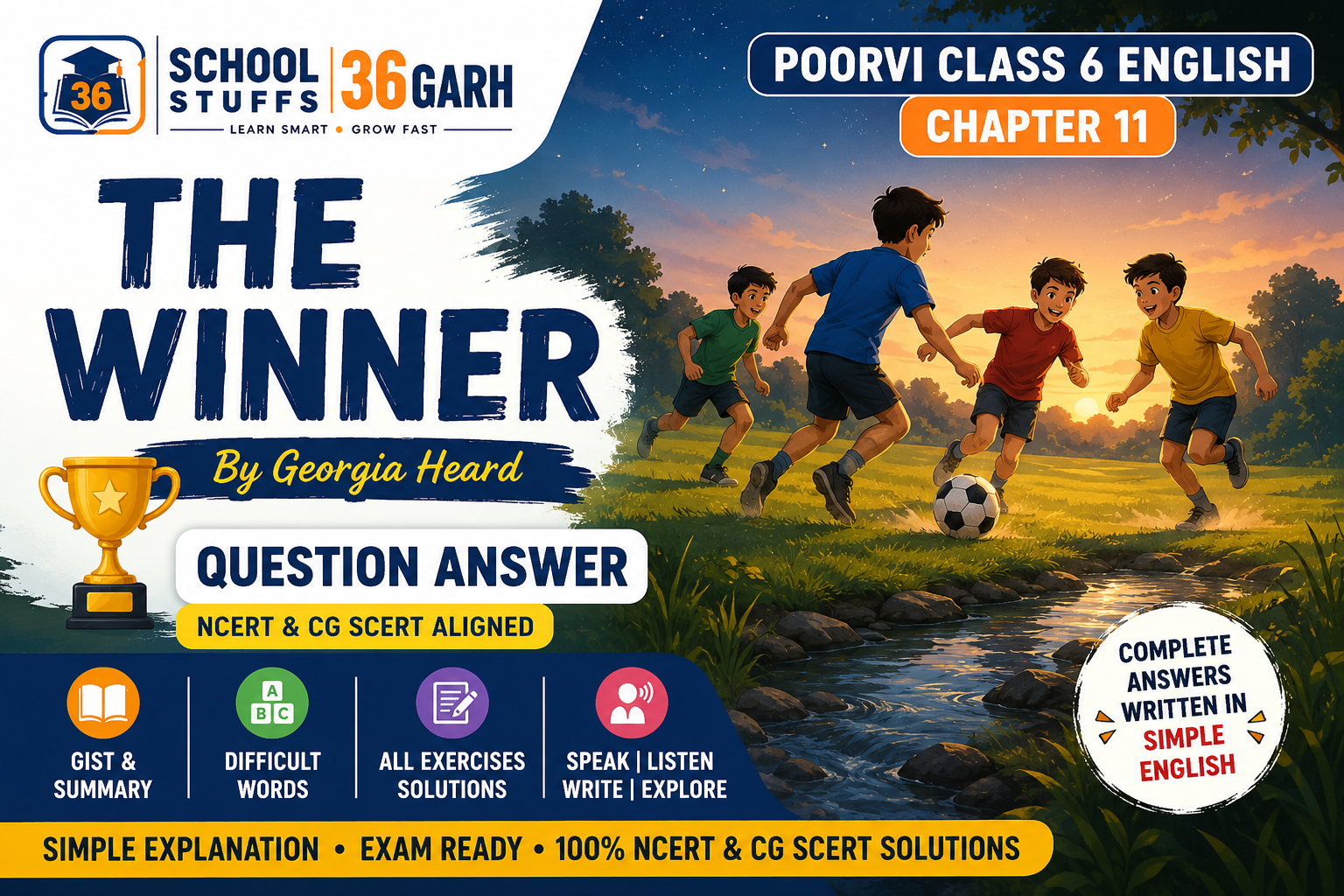
THE WINNER - SCHOOL STUFFS 36 GARH

The Winner Question Answer Class 6 Poorvi | CG SCERT English

Read The Winner Question Answer Class 6 Poorvi with summary, gist, difficult words, all textbook solutions, FAQs, and CG SCERT exam-ready answers.

Table of Contents

the-winner-question-answer-class-6

📖 Gist of the Lesson

The Winner is a beautiful poem written by Georgia Heard. The poem describes the happiness and excitement of children playing outdoors in the evening. They play ball together in their neighbour’s field beside a small creek, running so fast that they become breathless.

As time passes, the bright blue sky slowly becomes dark, the weather turns cooler, and the children begin to feel the cold grass under their feet. The trees appear to come closer because of the darkness. Finally, night arrives, and the children stop playing and return home. The poet beautifully says, “Night wins!”, using personification to show that night has ended their game.

The poem reminds us that childhood is full of fun, friendship, and outdoor games. It also teaches us to enjoy nature, spend time with friends, and understand that every enjoyable moment eventually comes to an end.

✨ Key Points

  • Children happily play together in the evening.
  • They enjoy outdoor games near a creek in their neighbour’s field.
  • They run so fast that they become breathless.
  • The evening slowly changes into night.
  • The poet uses personification by saying “Night wins!”
  • The poem celebrates childhood, friendship, nature, and outdoor play.
  • It reminds children to enjoy every moment with friends.

📝 Summary of the Lesson

The Winner is a short and beautiful poem written by Georgia Heard. It captures the excitement, energy, and happiness of children playing together outdoors in the evening. The poem shows how simple games with friends create some of the happiest moments of childhood.

The poem begins with a group of children playing ball in their neighbour’s field beside a small creek. They are full of energy and run so fast that the speaker cannot even catch her breath. This shows how much the children enjoy the game and how completely they are involved in playing.

As time passes, evening slowly changes into night. The bright blue sky becomes dark black, the grass becomes cold under the children’s feet, and the trees appear to move closer because darkness makes everything look different. These beautiful images help readers imagine the peaceful change from day to night.

Finally, the children realise that it is too dark to continue playing. Their game comes to an end, and they return home. Instead of simply saying that the game is over, the poet writes, “Night wins!” This is an example of personification, where night is given the human quality of winning a game.

The poem celebrates the joy of outdoor games, friendship, nature, and childhood. It also reminds children that every enjoyable moment has its own time. Just as day naturally changes into night, playtime also comes to an end, leaving behind beautiful memories.

🌟 Summary Highlights

  • The poem describes children happily playing outdoors in the evening.
  • They play ball near a creek in their neighbour’s field.
  • The children run so fast that they become breathless.
  • The evening gradually changes into night.
  • The cold grass and darkness signal the end of playtime.
  • The poet uses vivid imagery to describe nature.
  • “Night wins!” is an example of personification.
  • The poem teaches us to enjoy childhood, friendship, outdoor games, and nature.

📚 Difficult Words (English + Hindi)

The following words from The Winner will help students understand the poem easily and improve their vocabulary.

S.No.WordMeaning (English)Hindi Meaning (हिन्दी अर्थ)
1EveningsLate part of the day before nightसंध्या / शाम
2CreekA small stream of waterछोटी नदी / नाला
3Neighbour’sBelonging to a person living nearbyपड़ोसी का
4FieldAn open area of landखेत / मैदान
5CatchTo get or regainपकड़ना / प्राप्त करना
6BreathAir taken in and out while breathingसाँस
7Blue darkThe sky becoming dark at duskनीला अंधेरा / गोधूलि
8AchesHurts or painsदर्द होना
9CreepTo move slowly and quietlyधीरे-धीरे सरकना
10CloseNearपास
11Game’s overThe play has endedखेल समाप्त हो गया
12NightThe dark period after sunsetरात्रि
13WinsBecomes successful or victoriousजीतता है
14BreathlessUnable to breathe normally after runningहाँफता हुआ
15PersonificationGiving human qualities to non-living thingsमानवीकरण अलंकार
16OutdoorTaking place outsideबाहर का
17ExcitementA feeling of great joy and enthusiasmउत्साह
18ChildhoodThe period of being a childबचपन
19NatureThe natural world around usप्रकृति
20TwilightThe time between sunset and nightगोधूलि बेला

💡 Vocabulary Tip

Learn these difficult words and their meanings carefully. They will help you understand the poem better and score higher in vocabulary, comprehension, and grammar-based questions in exams.

🎯 Let Us Do These Activities Before We Read

Activity I

Look at the picture and answer the following questions.

1. What are these children doing?

Answer: The children are playing ball together happily in an open field.

2. Where do you think they are?

Answer: They are in their neighbour’s field near a small creek.

3. What is the time of the day?

Answer: It is evening. The sun is setting, and it is slowly becoming dark.

Activity II

Discuss the following questions with your classmates and teacher.

1. When do you go to play after school?

Answer: I usually go to play in the evening after completing my homework.

2. Who do you play with?

Answer: I play with my friends and classmates.

3. Where do you go to play in the evening?

Answer: I go to the playground or the nearby park to play in the evening.

4. Which games do you like playing?

Answer: I like playing cricket, football, badminton, and kho-kho.

5. When do you come back home?

Answer: I usually come back home before it gets dark.

💬 Let Us Discuss

Activity I

Read the given lines from the poem. Write the meaning of the lines by identifying the words/expressions in them.

S.No.Lines from the PoemMeaning
1next to the creekThe children are playing near a small stream of water.
2I can’t even catch my breathThe speaker has been running so fast that she becomes breathless.
3When blue dark turns to blackEvening is changing into night as the sky slowly becomes completely dark.
4trees creep closeBecause of the darkness, the trees appear to come closer even though they have not moved.

Activity II

Read the poem. Complete the following based on the poem.
Answer:  The children play ball in the evening in the neighbour’s field. They run so fast that they run out of breath. They continue to play till the evening when the blue sky turns black, and the trees are not clearly visible. They can feel their feet aching, now that it is cold. Finally, they stop playing and go home as it is night.

🤔 Let Us Think and Reflect

I. Read the given lines and answer the questions that follow.

We run so fast
I
can’t
even
catch
my
breath.

(i) Complete the sentence given below with the correct option.

The speaker needs to catch her breath because __________.

Answer: ✅ C. running fast results in being breathless.

(ii) Is the speaker alone? Why do you say so?

Answer: No, the speaker is not alone. She is playing with other children because the poem uses the word “we”, which shows that they are playing together.

(iii) What does the pattern in the lines tell us?

Answer: The pattern breaks the sentence into separate words to show that the speaker is breathing heavily after running very fast. It helps readers feel the speaker’s breathlessness.

Read the following lines and answer the questions.

When blue dark turns to black,
cold grass aches our feet,
trees creep close—
game’s over.
Night wins!

(i) Give one reason why the grass is cold.

Answer: The grass is cold because it is evening and the temperature becomes lower after sunset.

(ii) Complete the sentence suitably.

The children’s feet are aching because __________.

Answer: The children’s feet are aching because they have been running and playing barefoot on the cold grass for a long time.

(iii) Why does “Night” win?

Night wins because the __________.

Answer: ✅ A. time for play has ended.

II. Answer the following questions.

1. What is the central idea of the poem?

Answer: The central idea of the poem is the joy of childhood, outdoor games, friendship, and how nature gently brings playtime to an end as evening changes into night.

2. How does the poet describe the change from evening to night?

Answer: The poet describes the sky changing from blue to black, the grass becoming cold, and the trees appearing to come closer. These beautiful images show the gradual arrival of night.

3. What does the expression “Night wins!” mean?

Answer: It means that night has arrived, so the children have to stop playing and go home. The poet uses personification by giving the night the human quality of winning.

4. What values do you learn from the poem?

Answer:

  • Enjoy outdoor games and physical activities.
  • Spend quality time with friends.
  • Love and appreciate nature.
  • Understand that every enjoyable moment has an end.
  • Maintain a healthy balance between playtime and responsibilities.

🎯 Exam Tips

  • “We” shows the speaker is playing with friends.
  • “Night wins!” is an example of Personification.
  • The broken line pattern in “I can’t even catch my breath” shows breathlessness.
  • The poem celebrates childhood, friendship, outdoor games, and nature.

📖 Let Us Learn

1. Read the information given in the table and see what the poet has done in the poem “The Winner”.

Lines from the PoemWhat the Poet Has DoneOther Examples
I
can’t
even
catch
my
breath
The poet breaks the sentence into separate lines to show that the speaker is breathing heavily after running very fast. This special pattern helps readers imagine the child’s breathlessness.The leaves are
falling,
falling,
falling.
Night wins!The poet gives the human quality of winning to Night, which is a non-living thing. This figure of speech is called Personification.The sun played hide-and-seek with the clouds.

Now, write some examples of your own.

A. Write two examples using a special writing pattern.

Answer:

  • The rain kept falling, falling, falling.
  • I couldn’t stop laughing.

B. Write two examples of Personification.

Answer:

  • The moon smiled at the sleeping village.
  • The wind whispered through the trees.

💡 Grammar Corner – Personification

Personification is a figure of speech in which human qualities are given to animals, objects, or ideas.

SentencePersonification
The flowers danced in the breeze.Flowers are given the human action of dancing.
The stars winked at us.Stars are described as winking like humans.
The river sang a sweet song.The river is given the human ability to sing.
The clouds covered the sun lovingly.Clouds are shown behaving like humans.
Night wins!Night is treated like a player who wins a game.

🎯 Exam Tips

  • Personification means giving human qualities to non-living things.
  • The line “Night wins!” is the best example of personification in this poem.
  • The broken pattern in “I can’t even catch my breath” helps readers feel the speaker’s breathlessness.
  • Figures of speech are frequently asked in Class 6 examinations.

🎧 Let Us Listen

1. Listen to the riddles and write which sport is being referred to in the table below.

RiddleAnswer (Sport/Activity)
Riddle 1Football ⚽
Riddle 2Kabaddi 🤼
Riddle 3Swimming 🏊
Riddle 4Yoga 🧘

2. Complete the word web by writing the names of other water bodies.

Answer:

The poem mentions a Creek, which is a small water body. Some other water bodies are:

  • 🌊 River
  • 🏞️ Lake
  • 🌅 Pond
  • 🌍 Ocean
  • 🌊 Sea
  • 💧 Stream
  • 🏝️ Canal
  • 🌿 Waterfall
  • 🏞️ Reservoir
  • 🌎 Bay

🎯 Try It Yourself

Create a riddle about your favourite game, sport, or activity. Share it with your classmates and let them guess the correct answer.

Sample Riddle

I have a bat,
I have a ball,
Players run,
Crowds cheer for all.
Sometimes six,
Sometimes four,
Guess my name,
I am loved by all!

Answer: Cricket 🏏

💡 Learning Tip

  • Riddles improve your listening and thinking skills.
  • Learning the names of different water bodies helps build your vocabulary.
  • Creating your own riddles develops creativity and speaking skills.
  • Sports and games keep us healthy, active, and confident.

🗣️ Let Us Speak

Situation 1: Coming Home Late After Play

(Parent upset • Child explaining)

Parent: Why are you so late today? I was getting worried.

Child: I’m sorry, Mom. We were enjoying our game, and I didn’t notice it was getting dark.

Parent: You should always come home on time.

Child: You’re right. I’ll be more careful from tomorrow.

Parent: Good. Now wash your hands and get ready for dinner.

Child: Okay, Mom. Thank you.

Situation 2: Sharing Details of the Games You Played

(Child excited • Parent asking with interest)

Parent: Did you enjoy playing today?

Child: Yes! We played football in the playground.

Parent: Who was on your team?

Child: My friends Rahul, Aman, and Riya were on my team.

Parent: Who won the match?

Child: Our team won by two goals. We had so much fun!

Parent: That’s wonderful! Playing outdoor games keeps you healthy.

Child: Yes, I really enjoyed today’s game.

Situation 3: Bringing a New Friend Home After Playtime

(Child introducing • Parent welcoming)

Child: Mom, this is my new friend, Aryan.

Parent: Hello, Aryan! Welcome to our home.

Aryan: Thank you, Auntie.

Parent: Did both of you enjoy playing together?

Child: Yes. We played cricket with our friends.

Parent: That’s nice. Please come inside and have some snacks.

Aryan: Thank you very much!

Child: Thank you, Mom.

🌟 Useful Expressions for Speaking

SituationUseful Expressions
GreetingHello! Good evening! Welcome!
ApologisingI’m sorry. I won’t be late again.
IntroducingThis is my friend…
ThankingThank you. Thank you very much.
RespondingYou’re welcome. That’s great!

🎯 Speaking Tips

  • Speak clearly and confidently.
  • Maintain eye contact while speaking.
  • Use polite words such as PleaseSorry, and Thank You.
  • Listen carefully before replying.
  • Practice these dialogues with your classmates to improve your English communication skills.

✍️ Let Us Write

Write a paragraph about your playtime using the clues given below.

Clues:

  • What time do I go out to play?
  • Who do I play with?
  • What games do we play?
  • Which is my favourite game?
  • Why do I like it?
  • When do I return home?

✅ Model Paragraph

I usually go out to play at 5 o’clock in the evening after finishing my homework. I play with my friends in the nearby playground. We enjoy playing cricket, football, badminton, kho-kho, and hide-and-seek. My favourite game is cricket because it is exciting, improves teamwork, and keeps me physically active. Playing outdoor games makes me healthy, energetic, and happy. We play until sunset and return home before it becomes dark. After coming home, I freshen up, complete my remaining work, and spend time with my family. I always enjoy my playtime because it helps me relax, stay fit, and make wonderful memories with my friends.

📚 Useful Vocabulary

WordMeaning
PlaygroundAn open place where children play games.
TeamworkWorking together with others.
EnergeticFull of energy.
HealthyPhysically fit and strong.
RelaxTo feel fresh and free from stress.
Outdoor GamesGames played outside in the open air.

📝 Writing Tips

  • Write in simple and correct sentences.
  • Begin with when you go to play.
  • Mention who plays with you.
  • Describe your favourite game and why you like it.
  • End the paragraph by explaining how outdoor games help you stay healthy and happy.

🎯 Exam Tip

For Class 6 examinations, write your paragraph in 8–10 simple sentences. Use correct grammar, proper punctuation, and connect your ideas in a logical order.

🌍 Let Us Explore

🎯 Conclusion

The Winner is a delightful poem that beautifully captures the joy of childhood, outdoor games, friendship, and nature. Through simple yet vivid language, Georgia Heard reminds us that playing with friends is one of the happiest parts of growing up.

The poem also shows how nature gently signals the end of playtime as evening changes into night. The expression “Night wins!” is a wonderful example of personification, making the poem more interesting and meaningful.

The poem encourages children to enjoy outdoor activities, stay physically active, appreciate nature, and value the time spent with friends. It teaches that while every game eventually comes to an end, the memories created during play remain with us forever.

🌟 Moral of the Poem

  • Enjoy every moment of childhood.
  • Spend time playing outdoor games.
  • Value friendship and teamwork.
  • Respect nature and its daily rhythm.
  • Stay healthy through physical activities.

❓ Frequently Asked Questions (FAQs)


1. Who wrote the poem The Winner?

Answer: The poem was written by Georgia Heard.

2. What is the theme of the poem?

Answer: The poem celebrates childhood, outdoor games, friendship, nature, and the happiness of playing together.

3. Where do the children play?

Answer: They play ball in their neighbour’s field beside a small creek.

4. Why does the speaker become breathless?

Answer: The speaker becomes breathless because the children run very fast while playing.

5. What does “When blue dark turns to black” mean?

Answer: It means evening is slowly changing into night.

6. Why do the trees seem to creep close?

Answer: Because of the darkness, the trees appear to come closer even though they do not actually move.

7. What does “Night wins!” mean?

Answer: It means night has arrived, so the children must stop playing and return home.

8. Which figure of speech is used in “Night wins!”?

Answer: It is an example of Personification.

9. What values do we learn from the poem?

Answer: We learn the importance of friendship, outdoor games, teamwork, healthy living, and enjoying nature.

10. Why should children play outdoor games?

Answer: Outdoor games improve physical fitness, teamwork, confidence, discipline, and overall well-being.

📚 Related Lessons

ज्ञान बांटने से बढ़ता है, शेयर करें! - Share the article

आपको यह पोस्ट कैसी लगी? कोई सवाल या सुझाव? यहाँ लिखें

Leave a Comment

RELATED ARTICLES

QR Code
Scroll to Top