I. Who inspires you to do your best?
Sample Answer: My parents and teachers inspire me to do my best. Their encouragement motivates me to work hard, overcome difficulties, and never lose hope.
II. Work in pairs, identify what you see in the pictures given below. What can we learn from them?

Picture 1 – Bees building a beehive.
What we can learn –
- Hard work.
- teamwork.
- unity.
Picture 2 – A spider weaving its web.
What we can learn –
- Perseverance.
- patience.
Picture 3 – A flock of birds flying in the sky.
What we can learn –
- Cooperation.
- leadership.
- harmony.
Picture 4 – A bird weaving its nest.
What we can learn –
- Patience.
- effort.
- skill.
Picture 5 – group of ants working together
What we can learn –
- Discipline.
- dedication.
- determination.
Picture 6 – A tree full of ripe fruits
What we can learn –
- Selfless giving.
- patience.
- growth.
I. Complete the summary of the poem by filling in the blanks with suitable words from the text given in the box below. Share your answers with the teacher. An example has been given.
[ tried, mounted, despair, attempts, great, conquered, low, strive.]
ANSWER :
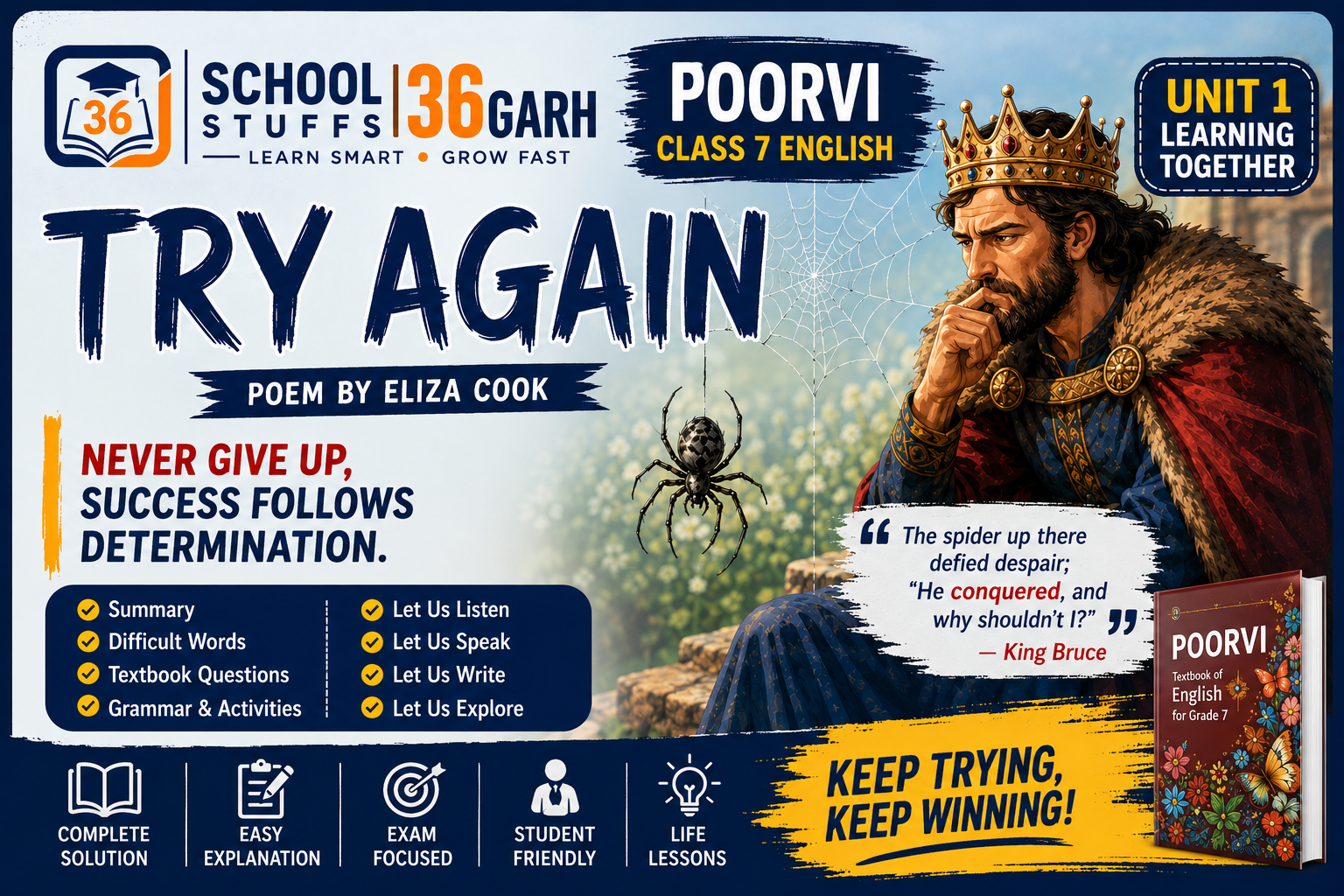
The poem, written in a narrative style, tells the story of King Bruce of Scotland, who was feeling 1. low after failing multiple times to achieve something 2. great for his people. In a moment of 3. despair, he observed a spider trying to reach its web high above. The spider 4. mounted every time it fell after getting close to its goal. It made nine 5. attempts and finally succeeded. The king said that the spider had 6. conquered and so would he. Inspired by the spider’s determination, King Bruce decided to 7. strive. When he 8. tried this time, he ultimately succeeded.
II. Complete the following sentences suitably.
1. We can say that the poet uses the narrative style becauseThe poem tells the story of King Bruce and the spider.2. The central idea of the poem is Perseverance and never giving up.
III. Pick three examples from the poem for each of the following.
1. Lines that describe the spider’s efforts
Examples from the poem:
- “It soon began to cling and crawl / Straight up with strong endeavour.”
- “Again it fell and swung below, / But again it quickly mounted.”
- “Steadily, steadily, inch by inch, / Higher and higher he got.”
2. Alliteration
Examples from the poem:
- strong endeavour
- silken, filmy
- Bravo, bravo!
IV. Why does the poet repeat the following words or phrases in the poem?
ANSWER : The poet repeats these words or phrases because –
- tried and tried – repeated efforts.
- steadily, steadily – continuous progress.
- up, up – repeated upward movement of the spider.
V. Fill in the blanks by choosing the correct answer.
ANSWER :
1. The rhyme scheme of the poem is ABAB
2. ‘Bravo’ is an example of interjection.
3. The poet uses ‘twas and ‘tis for the sake of rhythm.
VI.

1. Read the following sentences and identify metaphors and similes. Write M for metaphor and S for simile.
| S. No. | Sentence | Answer |
|---|---|---|
| (i) | He ran as fast as a cheetah. | S |
| (ii) | The world is a stage. | M |
| (iii) | The night was as dark as coal. | S |
| (iv) | He sang like an angel. | S |
| (v) | Her voice was music to his ears. | M |
| (vi) | The classroom was a zoo. | M |
| (vii) | The baby slept like a log. | S |
| (viii) | Her smile was as bright as the sun. | S |
| (ix) | The lake was a mirror, reflecting the sky. | M |
2. Read the following sentences and transform the similes to metaphors and metaphors to similes. Two examples have been given.
(i) Knowledge spreads like the branches of a mighty tree.
Knowledge is a spreading branch of a mighty tree.
(ii) His courage was a beacon, guiding us through the storm.
- His courage was as bright as a beacon guiding us through the storm.
• His courage was like a beacon guiding us through the storm.
ANSWER :
-
(iii) The book was a treasure chest, filled with endless adventures.
Simile: The book was like a treasure chest, filled with endless adventures. -
(iv) Her laughter was a melody that brightened the darkest days.
Simile: Her laughter was like a melody that brightened the darkest days. -
(v) The mountain stood as a guard, watching over the valley below.
Metaphor: The mountain was a guard, watching over the valley below. -
(vi) The night was like a velvet cloak, wrapping the world in mystery.
Metaphor: The night was a velvet cloak, wrapping the world in mystery. -
(vii) Her thoughts were like butterflies in a summer meadow.
Metaphor: Her thoughts were butterflies in a summer meadow.
I. Write the opposites of the following words taken from the poem.
ANSWER :
| Word | Opposite |
|---|---|
| up | down |
| fast | slow |
| glad | sad |
| win | lose |
| succeed | fail |
II. Choose the correct meaning of the underlined words in the following sentences from the box given below. Frame sentences of your own for these words.

ANSWER:
| Word/Phrase | Meaning |
|---|---|
| toil | work very hard and/or for a long time |
| braced | prepared themselves for something difficult |
| endeavour | an attempt to do something new or difficult |
| strive | to try very hard to achieve something |
III The poem uses words that show distance.
For example: a long way up, inch by inch, higher and higher, half-yard higher
Classify the words or phrases in the box given below based on the distance (far or near) and write in the space provided. You may take the help of a dictionary.
| Far (दूर) | Near (पास) |
|---|---|
| middle of nowhere | proximity |
| remoteness | vicinity |
| yonder | adjacent |
| afar | a stone’s throw |
| light year | hairline |
| farther |