
A BOTTLE OF DEW ACTIVITIES - PART - II
In our previous article, we explored the components of a lesson, including the Gist of the Lesson, Moral of the Lesson, Let Us Discuss 1, Let Us Discuss 2, and Let Us Think and Reflect.
In this article, we will dive into the various post-lesson activities, such as Let Us Learn, Let Us Listen, Let Us Speak, Let Us Write, and Let Us Explore.
Let’s get started!
📚 LET US LEARN
1. Read the following words from the story.
( promised, spending, cheated, luck, remember, huge, difficult, market, )
Use the words correctly to complete the paragraph given below. There are two extra words in the box that you do not need.
There was a farmer who had a huge coconut plantation. He worked hard and did not depend on luck. Every day was difficult but he did not give up. One day, a man bought a bag of coconuts from him, and promised to pay him the money the next day. Days passed and the man did not pay him anything. The farmer felt cheated. About two months later, he met the same man and asked him about his money. The man said, “Oh! I had forgotten. Now, I remember buying coconuts from you.” And he paid the money.
2. Read the words from the story in Column A. Read the new words in Column B.
Complete the meanings of the words given in Column B. Meanings of some words
are given.
| Column A | Column B | Meaning of words in Column B |
|---|---|---|
| I | eye | organ of sight |
| your | you’re | short form of ‘you are’ |
| dew | due | happening at some time in the future |
| son | sun | the star that gives light and heat to the earth |
| one | won | past tense of win |
| ate | eight | number after seven |
| see | sea | large body of salt water |
The words given in each row of the table above have the same sounds but
different spellings and meanings. Such words are called homophones.
EXAMPLE :-
| Homophone Pair | Words | Sentence |
|---|---|---|
| Pair 1 | ate – eight | I ate eight bananas for breakfast today. |
| Pair 2 | son – sun | The son was playing outside while the sun was shining brightly. |
| Pair 3 | see – sea | From the lighthouse, we can see the vast sea. |
| Pair 4 | dew – due | There was fresh dew on the grass early in the morning, and the gardener’s payment was due that day. |
3. Match the phrases in Column A with the phrases in Column B. Use the connecting words given in the middle column to make meaningful sentences.
ANSWER :
| Column A | Connecting Words | Column B |
|---|---|---|
| The children submitted their work | before | the deadline. |
| He did not want to try rock climbing | because | of his fear of heights. |
| The children ran towards the gate | as soon as | the bell rang. |
| Nitin was late to school today | as | there was a traffic jam. |
4. Here are two sentences with letter ‘b’. Read them slowly the first time. As you read them a few more times, read them faster each time.
- Bunty bhaiya bought a big bunch of bananas.
- A big bunch of bananas was bought by Bunty bhaiya.
Now, try to create a tongue twister on your own and share it with your peers.
ANSWER : Here are some tongue twisters, hopeit works :
Bobby baked bright brown bread before breakfast.
Bina bought blue balloons before boarding the bus.
Bittu’s big black bag broke by the bridge.
Bunny baked buttery biscuits beside the bakery.
Baby birds bathe beneath big banyan branches.
पूर्वी पुस्तक के यूनिट - 1 [FABLES AND FOLK TALES ] के पाठ और उनके समाधान पढ़ें :-
इन पाठों के समाधान पढ़कर छात्रों को अभ्यास और समझ में मदद मिलेगी। नीचे क्लिक कर खोलें:
📚 LET US LISTEN
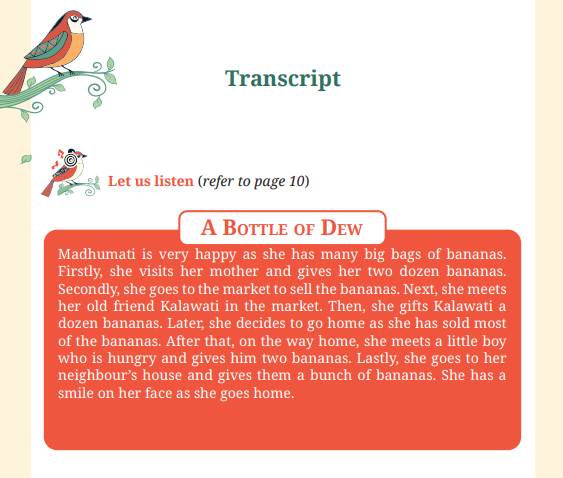
You will listen to what Madhumati does with the bananas from her plantation. As
you listen, number the events in the correct order in which they happen.
Write the number in the box beside each event. (refer to page 36 for transcript)
Here is the soluntion :-
| Serial | Event | Order |
|---|---|---|
| 1 | Gives two bananas to a boy who is hungry | 2 |
| 2 | Meets her friend Kalawati in the market | 3 |
| 3 | Visits her mother and gives her two dozen bananas | 5 |
| 4 | Chooses to go home as only some bananas were left | 7 |
| 5 | Visits her neighbour and gifts them a bunch of bananas | 6 |
| 6 | Gives twelve bananas to her friend | 4 |
| 7 | Goes to the market to sell the bananas | 1 |
📚 LET US SPEAK
शिक्षकों के लिए निर्देश
इस गतिविधि का उद्देश्य विद्यार्थियों को ‘s’ अक्षर के अलग-अलग उच्चारण पहचानना और सही तरीके से बोलना सिखाना है। नीचे दिए गए चरणों का पालन करें:
1. शब्दों का परिचय कराएँ –
( sage, promising, wisdom, trees, surprise )
विद्यार्थियों को बताएं कि इन सभी में ‘s’ अक्षर है, लेकिन इसका ध्वनि (sound) हर जगह एक जैसी नहीं है।
sage और promising – ‘s’ का उच्चारण /s/ (जैसे sun)
wisdom और trees – ‘s’ का उच्चारण /z/ (जैसे zoo)
surprise – पहले ‘s’ का उच्चारण /s/ और दूसरे का /z/
2. उदाहरण के साथ समझाएं –
बोर्ड पर शब्द लिखें।
हर शब्द को धीरे-धीरे और साफ बोलें।
विद्यार्थियों को आपके साथ दोहराने को कहें।
टिप: /z/ ध्वनि पहचानने के लिए विद्यार्थियों को गले पर हाथ रखकर बोलने को कहें। /z/ बोलते समय हल्की वाइब्रेशन महसूस होगी, जबकि /s/ में नहीं।
3. समूह अभ्यास करवाएँ –
पहले सभी विद्यार्थी एक साथ शब्द बोलें।
फिर 3-4 विद्यार्थियों का छोटा समूह चुनें और उनसे बोलवाएँ।
अंत में, 1-1 विद्यार्थी को शब्द बोलने दें।
4. सुनने और लिखने का अभ्यास –
कुछ नए शब्द बोलें जिनमें ‘s’ आता हो।
विद्यार्थियों को तय करना है कि उसमें /s/ है या /z/।
वे अपने नोटबुक में शब्द के पास /s/ या /z/ लिखेंगे।
गतिविधि के अंत में विद्यार्थियों को याद दिलाएं कि ‘s’ की आवाज़ हमेशा एक जैसी नहीं होती और यह अभ्यास उनकी स्पीकिंग और लिसनिंग स्किल को बेहतर बनाएगा।
उदाहरण के साथ समझाएं
बोर्ड पर दो कॉलम बनाएँ — /s/ sound और /z/ sound
| /s/ Sound | /z/ Sound |
|---|---|
| sun | zebra |
| sit | lazy |
| salt | please |
| simple | goes |
| school | roses |
Write the sound next to the word.
( beds, sand, clothes, sea, was, keys, bags, nose, )
beds – /z/ – (ज़)
sand – /s/ – (स)
clothes – /z/ – (ज़)
sea – /s/ – (स)
was – /z/ – (ज़)
keys – /z/ – (ज़)
bags – /z/ – (ज़)
nose – /z/ – (ज़)
2. Pair Work : Do a role play of the sage and Raman after Raman became rich.
Pair Work – Role Play – Script Example
Situation: This conversation takes place after Rama Natha has become rich through hard work in his banana plantation.
Rama Natha:
“Namaste, Gurudev! Your guidance has changed my life. Now I have a large banana plantation and a lot of wealth.”
Sage:
“I am happy to see that you worked with patience and dedication. That is the real magic potion — hard work.”
Rama Natha:
“Yes, Gurudev! Earlier, I was spending my wealth carelessly, but you showed me the path to work on my land.”
Sage:
“Remember, my son, trust not in luck, but in your own deeds.”
Rama Natha:
“Yes, Gurudev. I will continue to work hard and also help the people in my village.”
Sage:
“That is true prosperity. May God bless you more.”
Teacher Tip:
Let students act out the scene — one as the sage (with a shawl or robe) and the other as Rama Natha (as a farmer).
Encourage them to speak with expression and correct pronunciation.


Pingback: THE UNLIKELY BEST FRIENDS - SCHOOL STUFFS 36GARH
Pingback: A Bottle Of Dew - SCHOOL STUFFS 36GARH