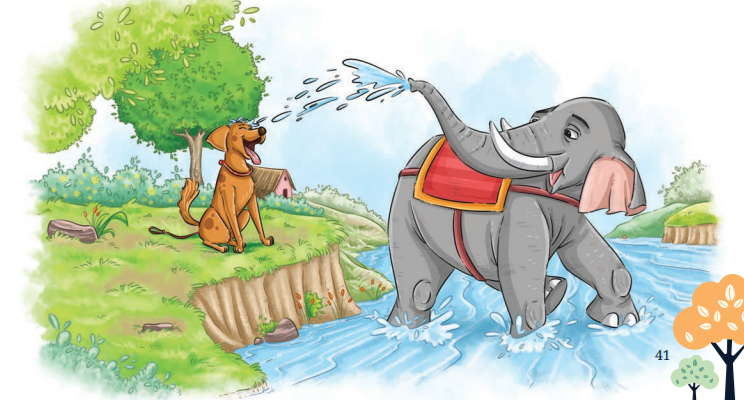

Have you ever formed a bond with someone totally different from you? “The Unlikely Best Friends” is a heartwarming story that proves true friendship knows no boundaries—not size, species, or background. This beautiful folk tale, featuring an enormous elephant and a tiny dog, teaches us about empathy, loyalty, and the deep emotional connection that can form when we look past differences.
The story is about an elephant named Gajaraj who lives in a royal stable but is very lonely. His caretaker, the mahout, is kind but not a friend. One evening, a hungry, stray dog named Buntee wanders in. Gajaraj shares his food, and the two instantly bond. They spend their days together, playing near the water, though Buntee hates the water splashes!
One day, Buntee’s owner, a farmer, finds him and takes him home. Gajaraj is devastated and refuses to eat. Simultaneously, Buntee at the farmer’s house also rejects all food. The farmer, recognizing the dog’s profound sadness and missing his own kind elephant ride, and remembering the joy Buntee felt riding Gajaraj, realizes the depth of the friendship. He kindly frees Buntee to return to his friend.
When Buntee returns, Gajaraj is overjoyed. Seeing the elephant and dog happily reunited and finally eating, the mahout hugs the farmer and says, “It’s not only Gajaraj who has found a friend, I’ve also found one.”
पाठ का हिंदी सारांश –
गजराज नामक हाथी अपने शाही अस्तबल में अकेला और उदास रहता था। उसका कोई दोस्त नहीं था। एक शाम, एक आवारा कुत्ता, बंटी, अस्तबल में आ गया। गजराज ने उसे भोजन दिया, और उन दोनों के बीच तुरंत दोस्ती हो गई। वे रोज़ साथ में खेलते और गजराज, बुंटी को अपनी सूंड से उठाकर अपनी पीठ पर सवारी कराता था।
परंतु एक दिन, बंटी का मालिक, एक किसान, उसे ढूंढता हुआ आया और उसे घर ले गया। बिछड़ने के कारण गजराज और बंटी दोनों इतने दुखी हुए कि उन्होंने खाना छोड़ दिया।
बंटी के दुख को देखकर, किसान ने उसकी दोस्ती को समझा और उसे आज़ाद कर दिया। बंटी भागकर अस्तबल वापस आया और हाथी से मिला। दोनों दोस्त खुशी से झूम उठे और खाना शुरू कर दिया। यह देखकर, महावत ने किसान को गले लगा लिया और कहा कि उन्हें भी एक नया दोस्त मिल गया है। इस प्रकार, कहानी में हाथी और कुत्ता, साथ ही महावत और किसान, दोनों को दोस्ती मिलती है।
'' LET US DO "
Let us do these activities before we read.
I. Friends are an important part of our lives. Why do you think so? Share your ideas with your friend. What do you do when you are with your friends and how do you feel?
Now, complete the following sentences by writing in the shapes given below. Share your completed sentences with your classmates and teacher. One has been done for you.
ANSWER :
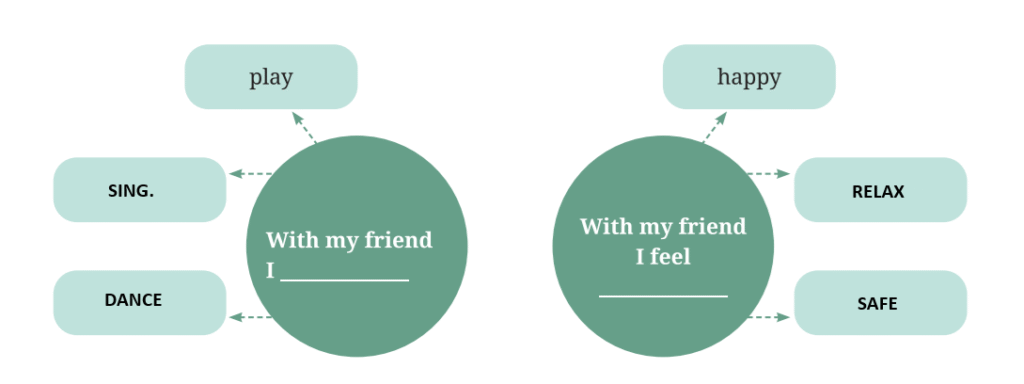
The title of the chapter is ‘The Unlikely Best Friends’.
(1) What can be the meaning of ‘unlikely’? Discuss in groups, and then discuss with your teacher.
Answer: ‘Unlikely’ means not probable or not expected to happen. In the context of friendship, it means a relationship between two individuals (or animals) that is surprising or unexpected because they have vast differences (like size, species, or background).
(2) Can you think of some unlikely friends? Share your answer with your teacher.
Answer: A cat and a bird, a goat and a tiger cub, a bear and a wolf.
LET US DISCUSS -1
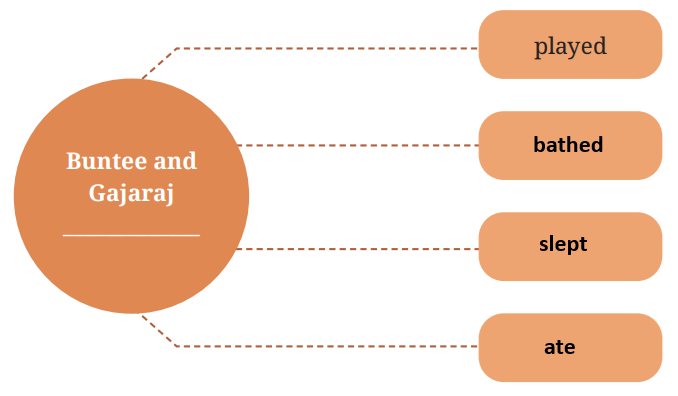
1. Talk about the things that Gajaraj and Buntee did together. Now, write in the shapes given below. One has been done for you.
ANSWER :
2. Why did the farmer hug Buntee?
ANSWER : The farmer was Buntee’s owner, and he was happy to find Buntee, whom he had been looking for ever since he disappeared from his house.
2. Do you think Buntee will leave Gajaraj and go home with the farmer?
ANSWER : No, Buntee will not happily leave Gajaraj because the strong bond and friendship they shared were clearly visible (Buntee yelped when pulled away).
LET US DISCUSS -2
1. Why did Gajaraj not eat his food?
ANSWER : Gajaraj was deeply saddened and depressed because he was missing his friend, Buntee.
2. Who were friends at the end of the story?
ANSWER : The story ends with two sets of friends:
The elephant Gajaraj and the dog Buntee.
The Mahout and the Farmer.

पूर्वी पुस्तक के यूनिट - 1 [FABLES AND FOLK TALES ] के पाठ और उनके समाधान पढ़ें :-
इन पाठों के समाधान पढ़कर छात्रों को अभ्यास और समझ में मदद मिलेगी। नीचे क्लिक कर खोलें:
LET US THIN AND REFLECT
1. “Are you missing your friend?” asked the farmer
remembering the happy look on Buntee’s face while sitting
on the elephant’s back. “I cannot see you go hungry,” said
the farmer, “If you miss your friend so much, go to him.” The
farmer removed the rope with which he had tied the dog.
(i) The farmer uses the word FRIEND to refer to the elephant.
(ii) How did the farmer know that Buntee was hungry?
ANSWER : He knew Buntee was hungry because the dog had not touched his food ever since he was brought home.
(iii) Why did the farmer remove the rope with which he had tied Buntee?
ANSWER : He removed the rope out of empathy and respect for the strong bond Buntee had with Gajaraj.
(iv) Complete with one word: Gajaraj : Buntee : : Mahout : farmer
2. Give two examples to show that Gajaraj was very happy to have a friend.
ANSWER :
Gajaraj immediately shared his food with the stray dog.
He picked Buntee up with his trunk and gave him a joyous swing when Buntee returned.
3. How did the mahout come to know that Gajaraj was sad?
ANSWER : The mahout became worried when Gajaraj refused to eat his favourite food for two consecutive days, even though he found nothing wrong with his stomach.
4. Why do you think Buntee licked the farmer’s hand?
ANSWER : Buntee licked the farmer’s hand to show gratitude for understanding the depth of his friendship and allowing him to return to Gajaraj.
5. What was ‘unlikely’ about the friendship of Gajaraj and Buntee?
ANSWER : The unlikelihood lay in their massive difference in species and physical size. An elephant and a dog are naturally not expected to form such a deep, mutual bond.
LET US LEARN
1. Gajaraj was sad without a friend and when he met Buntee, he was filled with joy. ‘Sad’ and ‘filled with joy’ are opposites. Opposites can also be formed by adding some letters before a word. For example, un+happy=unhappy, in+correct=incorrect, dis+connect=disconnect, mis+use=misuse. Now, take help from the words given as hints and fill up their opposites in the puzzle.
(Note: All the words are from the story you have just read.)
ANSWER :
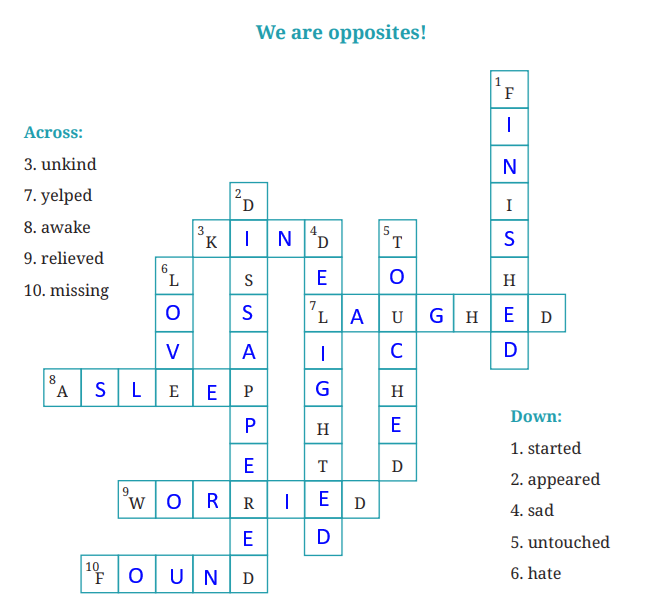
2. Now, complete the paragraph with some of the words you have used in the puzzle.
ANSWER :
My pencil was missing. I was very sad as it was a gift from my friend. I woke up my elder brother who was asleep on the bed. I told him that my pencil seemed to have disappeared. He laughed and told me to look under my pillow. I was relieved when I found the pencil there.
3. The words that tell us about an action are called verbs. In the story, the author tells us what happened before. To do that, the past form of the action word (verb) is used. Let us learn about the three forms of past tense.
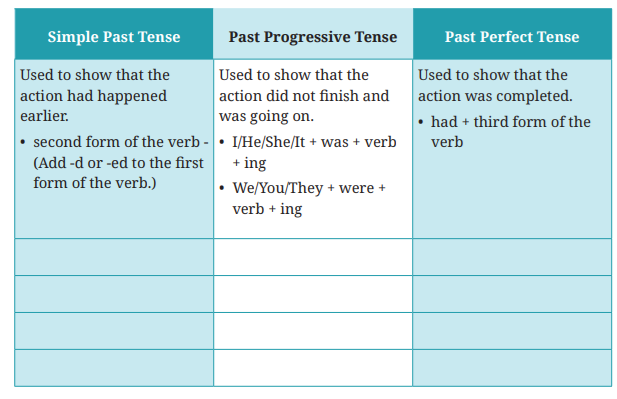
Given below are some verbs from the story. Put the verbs in their correct column in the table given above.
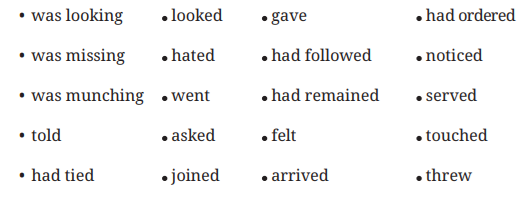
Select the correct form of the verb to complete the passage. Check your answers with the teacher.
The farmer came back and noticed (noticed/was noticing/had noticed) that Buntee was sad. He had tied (tied/ was tying/had tied) Buntee with a rope the day before. He asked (asked/was asking/ had asked) Buntee why he was sad. The farmer felt (felt/was feeling/had felt) that Buntee was missing
(missed/was missing/had missed) Gajaraj and set him free.
4. ‘…neither the farmer nor the mahout noticed that the two friends were in tears.’
The words ‘neither’, ‘nor’ are used to state that the farmer and the mahout did not notice the same thing. ‘Neither, nor’ connect two negative choices.
For example: Neither Rohit nor I want to play football.
When you need to choose between two things that you want, you may use ‘either, or’.
For example: Rohit wants to play either cricket or kho-kho.
It means Rohit wants to play cricket or Rohit wants to play kho-kho.
Discuss the given sentences with your teacher to practise.
• Neither Shikha nor Anuj like to tell stories.
• Either Bhavesh or Abha made this painting.
ANSWER :
Neither Shikha nor Anuj like to tell stories.
👉 Meaning: Shikha doesn’t like to tell stories, and Anuj also doesn’t like to tell stories.
✅ Correct form: Neither Shikha nor Anuj likes to tell stories.
(Here the verb likes is singular because it follows the subject closest to it — Anuj.)Either Bhavesh or Abha made this painting.
👉 Meaning: One of them made the painting — Bhavesh or Abha, but not both.
✅ Correct form: Either Bhavesh or Abha made this painting.
LET US LISTEN
1. You will listen to another story about ‘Unlikely Friends’. Use exact words from the story to fill up the missing details in the paragraph. (refer to page 69 for transcript)
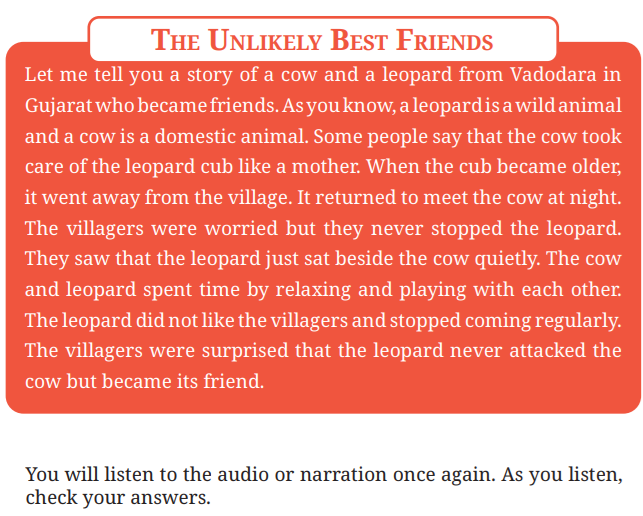
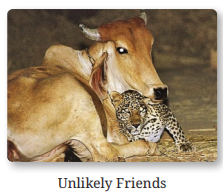
The leopard is a wild animal but it became a friend of a cow. When the leopard grew up, it left the village. It came in the night to meet the cow. The leopard would sit beside the cow. They also played together. People were surprised at their friendship.
2. Now, listen to the story again and number the sentences in correct order. The first one has been done for you.
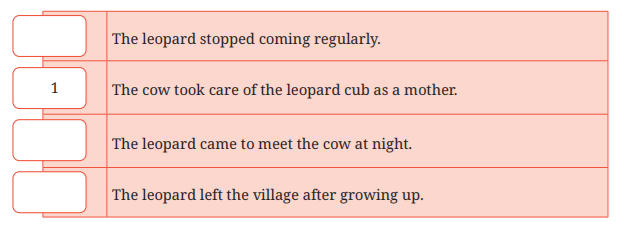
ANSWER :
| Order | Sentence |
|---|---|
| 1️⃣ | The cow took care of the leopard cub as a mother. |
| 2️⃣ | The leopard left the village after growing up. |
| 3️⃣ | The leopard came to meet the cow at night. |
| 4️⃣ | The leopard stopped coming regularly. |
LET US SPEAK
DEAR TEACHERS,
On this speaking section Encourage your students to speak freely and confidently about their likes and dislikes. The goal is not grammatical perfection but natural communication. You can begin by modelling a short conversation using the example from the book (Gajaraj and Buntee). Pair up students who are shy with those who are more expressive, and remind them to listen carefully to each other’s responses. This activity helps in building spoken fluency, listening skills, and confidence in expressing similarities and differences in daily life.
प्रिय शिक्षक मित्रों,
पाठ के इस भाग में छात्रों को प्रोत्साहित करें कि वे अपनी पसंद और नापसंद के बारे में स्वतंत्र और आत्मविश्वास से बात करें। उद्देश्य केवल व्याकरण की शुद्धता नहीं है, बल्कि स्वाभाविक रूप से संवाद करना है। आप पुस्तक में दिए उदाहरण (गजराज और बंटी) का प्रयोग करके एक छोटी-सी बातचीत दिखाकर शुरुआत कर सकते हैं। शर्मीले बच्चों को ऐसे बच्चों के साथ जोड़ी बनाकर रखें जो अधिक आत्मविश्वासी हैं, और उन्हें याद दिलाएँ कि वे एक-दूसरे की बात ध्यान से सुनें।
यह गतिविधि छात्रों में बोलने की प्रवाह क्षमता, सुनने की कुशलता और समानताओं व भिन्नताओं को आत्मविश्वास से व्यक्त करने की योग्यता विकसित करती है।
LET US WRITE
Question:
Write six sentences about your friend with the help of the facts collected in the above task. Mention how you are not only similar but also different. You may take help of the words given below.
( same, different, and, but, both, still, like, unlike, neither, nor, either, or )
Sample Answer:
My friend Aarav and I study in the same class.
Both of us like playing football after school.
I like reading storybooks, but my friend likes drawing.
We are different in our hobbies, yet we enjoy spending time together.
Neither of us likes to fight with anyone.
Our choices are different, but our friendship is strong and happy.
LET US EXPLORE
DEAR TEACHERS,
This section is designed to extend learning beyond the story and connect it with real-life examples and values. Encourage students to explore the Jataka tales to understand universal human values such as kindness, friendship, wisdom, and compassion. You can divide the class into small groups and assign each group a short Jataka story to read and present. This will develop reading, speaking, and comprehension skills.
During the discussion on elephants, guide students to think critically about human–animal relationships and environmental conservation. Relating the story of Gajaraj and Buntee to the real-life friendship of Tarra and Bella can help students see how empathy and love cross all boundaries.
Conclude by highlighting that “Let Us Explore” activities aim to build curiosity, awareness, and moral understanding among learners — essential goals of NEP 2020.
प्रिय शिक्षक मित्रों,
यह भाग विद्यार्थियों को कहानी से आगे सोचने और वास्तविक जीवन से जोड़ने के लिए बनाया गया है। छात्रों को प्रेरित करें कि वे जातक कथाएँ (Jataka Tales) पढ़ें और उनमें निहित मानवीय मूल्यों — जैसे दया, मित्रता, बुद्धिमत्ता और करुणा — को समझें। कक्षा को छोटे-छोटे समूहों में बाँटें और प्रत्येक समूह को एक छोटी जातक कथा पढ़ने और प्रस्तुत करने का कार्य दें। इससे छात्रों में पढ़ने, बोलने और समझने की क्षमता विकसित होगी।
हाथियों पर आधारित चर्चा के दौरान छात्रों को यह सोचने के लिए प्रोत्साहित करें कि मनुष्य और जानवरों के बीच संबंध कैसे बदल रहे हैं और पर्यावरण की रक्षा क्यों ज़रूरी है। “गजराज और बंटी” की कहानी को “तारा और बेला” (हाथी और कुत्ते की सच्ची कहानी) से जोड़ने पर छात्र समझ पाएँगे कि प्रेम और सहानुभूति जाति या प्रजाति की सीमाओं से परे होती है।
अंत में यह बताएं कि “Let Us Explore” गतिविधियों का उद्देश्य विद्यार्थियों में जिज्ञासा, जागरूकता और नैतिक समझ को विकसित करना है — जो नई शिक्षा नीति (NEP 2020) के प्रमुख लक्ष्य हैं।