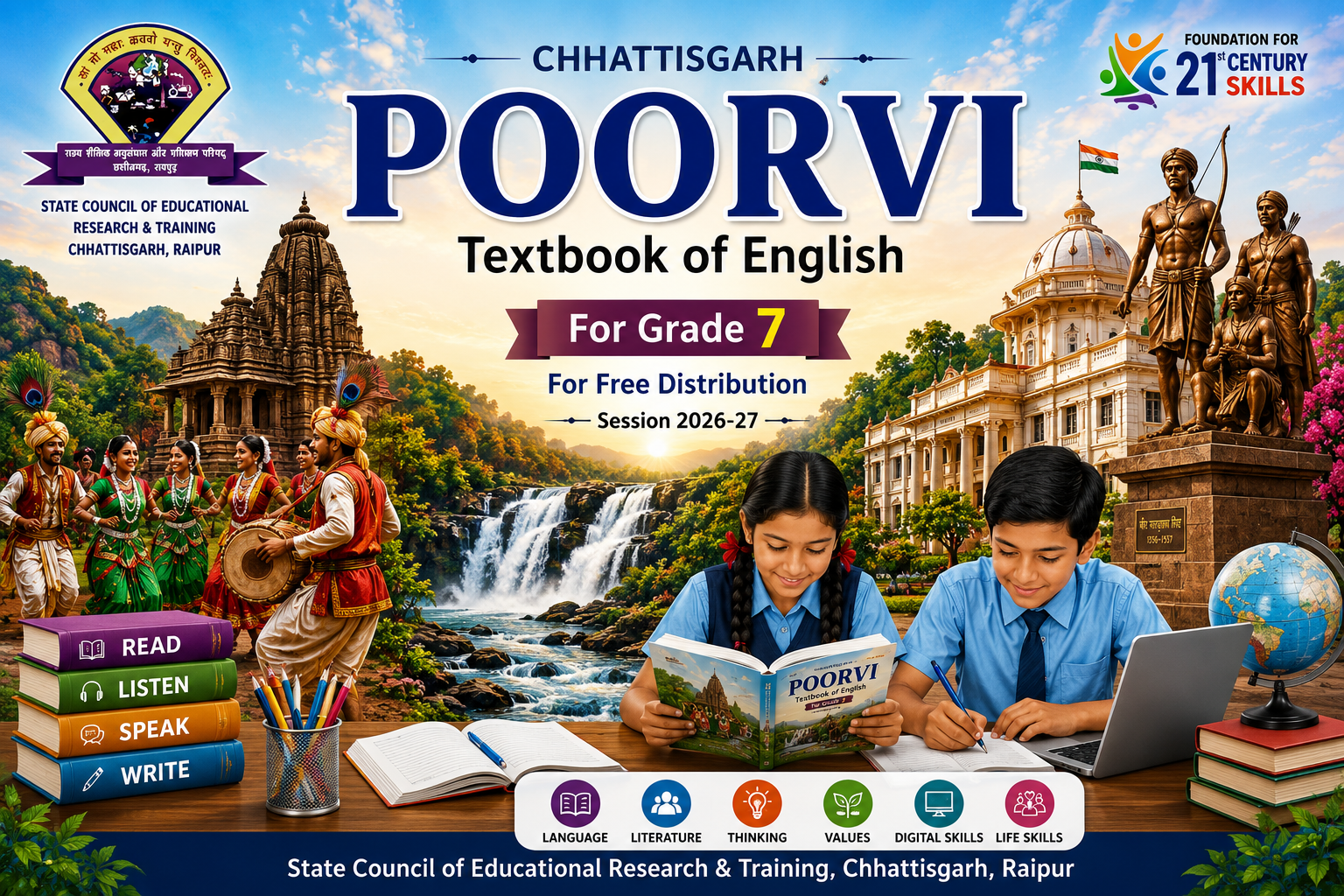
CG Poorvi Class 7: Transforming English Learning in Chhattisgarh
The English language textbook “Poorvi” for Class 7 is an important step towards transforming school education in India. Developed in alignment with the vision of the National Education Policy (NEP) 2020 and the National Curriculum Framework for School Education (NCF-SE) 2023, this textbook represents a modern, activity-based, competency-oriented approach to language learning.
The State Council of Educational Research and Training, Chhattisgarh (SCERT) adapted this textbook to suit the educational needs of students in the state. The book is not merely a collection of lessons. It is a carefully designed educational resource that focuses on communication, creativity, critical thinking, values, inclusion, and experiential learning.
Unlike traditional English textbooks that focused heavily on rote memorization and grammar drills, CG Poorvi Class 7 adopts a learner-centred methodology. Students are encouraged to read independently, think critically, express themselves confidently, and connect classroom learning with real-life experiences.
The textbook combines stories, poems, plays, autobiographies, memoirs, diary entries, letters, travel narratives, and conversations. These literary forms help students develop language skills naturally while engaging with meaningful themes such as perseverance, nature, humour, travel, bravery, teamwork, inclusion, and patriotism.
According to the textbook foreword, the Middle Stage of education acts as a bridge between the Preparatory Stage and Secondary Stage, helping learners develop analytical, descriptive, and narrative capabilities.
This textbook successfully reflects that vision.
Vision Behind CG Poorvi Class 7
The development of Poorvi is rooted in the broader educational transformation envisioned by NEP 2020. The policy aims to create an education system that is deeply connected to Indian culture and values while preparing students for the challenges of the 21st century.
The textbook emphasizes:
Holistic development
Competency-based learning
Communication skills
Experiential learning
Critical thinking
Inclusivity
Cultural awareness
Joyful learning
Indian Knowledge Systems
Real-world application of language
The textbook fosters natural curiosity among students and develops competencies in listening, speaking, reading, and writing through intelligently designed activities.
This shift from textbook-centred teaching to activity-centred learning is one of the strongest features of CG Poorvi Class 7.
Alignment with NEP 2020 and NCF-SE 2023
One of the biggest strengths of CG Poorvi Class 7 is its alignment with national educational reforms. The textbook clearly states that it has been developed according to the Curricular Goals (CGs) mentioned in NCF-SE 2023.
Curricular Goals – The six major curricular goals are:
CG-1: Independent Reading and Comprehension
Students learn to read and understand different types of texts including stories, poems, essays, plays, and articles.
CG-2: Expression of Thoughts and Feelings
Learners are encouraged to write about experiences, social events, emotions, and personal reflections.
CG-3: Effective Communication
The textbook develops communication skills through questioning, discussion, analysis, and response-based activities.
CG-4: Understanding Literary Devices
Students explore literary forms, poetic expressions, imagery, humour, symbolism, and narrative styles.
CG-5: Linguistic Awareness
Grammar and vocabulary are integrated naturally within meaningful contexts rather than taught separately.
CG-6: Appreciation of Language
Students learn rhymes, sounds, scripts, puns, pronunciation, and wordplay in engaging ways.
These curricular goals make English learning more practical, enjoyable, and competency-based.
Structure of the CG Poorvi Class 7 Textbook
The textbook contains five thematic units. Each unit includes stories, poems, conversations, narratives, and various skill-based activities.
The five major units are:
Learning Together
Wit and Humour
Dreams and Discoveries
Travel and Adventure
Bravehearts
Each unit follows a structured pedagogical approach that includes:
Let us do these activities before we read
Let us read
Let us discuss
Let us think and reflect
Let us learn
Let us listen
Let us speak
Let us write
Let us explore
This systematic design ensures integrated language development.
Unit 1: Learning Together
The first unit focuses on the interconnectedness of nature and human life.
Major Lessons
The Day the River Spoke
Try Again
Three Days to See
Key Themes
Courage
Perseverance
Education
Nature
Inclusion
Sensitivity
“The Day the River Spoke” encourages students to listen to nature and overcome fears. The river motivates Jahnavi to pursue education fearlessly.
“Try Again” inspires resilience and determination. The message of perseverance becomes especially relevant for middle school learners facing academic and personal challenges.
“Three Days to See,” inspired by Helen Keller, encourages appreciation of the senses and empathy toward visually impaired individuals.
The listening activity about Braille and Digital India introduces inclusion and assistive technologies for visually impaired people.
This reflects NEP 2020’s emphasis on inclusive education.
Unit 2: Wit and Humour
The second unit introduces students to humour, imagination, and communication.
Major Lessons
Animals, Birds, and Dr. Dolittle
A Funny Man
Say the Right Thing
Key Themes
Humour
Communication
Animal care
Misunderstanding
Creativity
The story “Animals, Birds, and Dr. Dolittle” introduces learners to a doctor who communicates with animals.
This imaginative narrative develops curiosity and empathy for animals.
The play “Say the Right Thing” highlights the importance of effective communication and careful listening.
Through humour and comic situations, students learn practical communication skills.
Unit 3: Dreams and Discoveries
This unit focuses on imagination, creativity, exploration, and aspirations.
Major Lessons
Paper Boats
North, South, East, West
Key Themes
Dreams
Creativity
Travel
Exploration
Imagination
The unit includes diary entries, letters, postcards, and reflective writing tasks that improve expressive writing.
Students explore travel experiences across India through postcards and personal narratives.
Activities related to origami, eco-friendly crafts, and fragrant flowers help integrate creativity with language learning.
The unit successfully blends literature with experiential activities.
Unit 4: Travel and Adventure
This unit inspires students to explore geography, adventure, and resilience.
Major Lessons
Travel and Adventure
Conquering the Summit
Key Themes
Adventure
Tourism
Determination
Mountaineering
Indian Railways
“Conquering the Summit” narrates the inspiring story of Arunima Sinha, who overcame severe physical challenges to climb Mount Everest.
This lesson promotes determination and self-belief.
The textbook also introduces learners to:
Mountain Railways of India
UNESCO Heritage Sites
Vande Bharat Express
Underwater metro routes in India
These activities connect language learning with geography, technology, and national development.
Unit 5: Bravehearts
The final unit is dedicated to bravery, sacrifice, patriotism, and leadership.
Major Lessons
My Dear Soldiers
Rani Abbakka
Key Themes
Patriotism
Sacrifice
Courage
Leadership
National pride
“My Dear Soldiers” by A. P. J. Abdul Kalam pays tribute to Indian soldiers.
The poem develops respect for armed forces and national service.
The lesson on Rani Abbakka introduces students to one of India’s early women warriors who resisted Portuguese colonial power.
The unit integrates history, leadership, women empowerment, and patriotism beautifully.
Activity-Based Learning Approach
One of the defining features of CG Poorvi Class 7 is its activity-rich structure.
Instead of passive reading, students actively participate through:
Discussions
Role play
Listening tasks
Pair work
Group projects
Presentations
Creative writing
Craft activities
Research assignments
Public speaking
For example:
Students design badges for soldiers.
They create diamante poems.
They prepare presentations on heritage railways.
They write diary entries and leave applications.
This approach develops confidence, collaboration, and creativity.
Integration of Four Language Skills
The textbook effectively integrates all four language skills:
Reading –
Students engage with stories, poems, letters, biographies, and plays.
Writing –
Activities include:
Diary writing
Letter writing
Descriptive paragraphs
Applications
Gratitude notes
Poetry writing
Listening –
Listening exercises are included in every unit with guided comprehension activities.
Speaking –
Students participate in:
Discussions
Presentations
Pair conversations
Public speaking activities
This balanced integration reflects competency-based education.
Focus on Indian Knowledge Systems and Culture
The textbook beautifully integrates Indian heritage, traditions, and cultural identity.
Students learn about:
Indian soldiers
National memorials
Heritage railways
Regional flowers
Women freedom fighters
Indigenous innovations
Indian geography
Cultural diversity
The textbook explicitly mentions that “Let us Explore” activities connect learners with Indian Knowledge Systems and cultural heritage.
This helps learners remain rooted in Indian identity while developing global competencies.
Inclusion and Gender Sensitivity
CG Poorvi Class 7 strongly promotes inclusivity and gender equality.
Examples include:
Lessons on visually impaired individuals
Representation of women warriors
Equal recognition of male and female soldiers
Activities promoting empathy and cooperation
The textbook also includes themes related to accessibility, digital inclusion, and social equality.
This aligns with the inclusive vision of NEP 2020.
Grammar and Vocabulary in Context
Unlike traditional grammar-heavy textbooks, Poorvi teaches grammar naturally within context.
Students learn:
Direct and indirect speech
Silent letters
Pronunciation
Vocabulary usage
Comparative expressions
Rhyming words
Idioms and phrases
For example:
The lesson on Rani Abbakka introduces spelling patterns like “ie” and “ei” through contextual learning.
Similarly, pronunciation exercises teach stress and silent letters.
This contextual approach makes grammar learning more meaningful.
Critical Thinking and Reflection
The textbook regularly encourages students to think deeply rather than memorize answers.
Sections like:
Let us think and reflect
Let us discuss
Let us explore
promote:
Analysis
Interpretation
Reasoning
Opinion building
Personal response
Students are encouraged to ask questions, debate ideas, and express viewpoints confidently.
This marks a significant shift from rote learning to reflective learning.
Visual Appeal and Illustrations
The textbook contains thoughtfully designed illustrations that support comprehension and engagement.
The visuals help:
Simplify difficult ideas
Maintain learner interest
Improve contextual understanding
Support visual learners
The colourful presentation makes the book learner-friendly and interactive.
Teacher and Learner Friendly Design
Another strength of CG Poorvi Class 7 is its classroom usability.
Teachers benefit from:
Structured lesson flow
Skill-based activities
Clear competency alignment
Integrated assessments
Discussion prompts
Students benefit from:
Interactive tasks
Simple language
Engaging themes
Real-life connections
Creative freedom
The textbook supports joyful learning rather than exam-oriented pressure.
Importance of Experiential Learning
Experiential learning is central to the textbook.
Students learn through:
Observation
Interaction
Exploration
Research
Presentation
Reflection
For example:
Craft presentations
Heritage railway research
Group discussions
Poetry creation
Character descriptions
These activities help students “learn by doing.”
Role of Assessment in Poorvi
Assessment in the textbook is continuous and competency-based.
Instead of focusing only on written exams, the book includes:
Oral responses
Group participation
Listening comprehension
Writing tasks
Creative activities
Reflective thinking
The textbook itself states that activities serve as “assessment as and for learning.”
This approach reduces exam fear and supports holistic development.
Contribution of NCERT and SCERT Chhattisgarh
The development of Poorvi involved experts from NCERT, SCERT Chhattisgarh, teachers, academicians, and subject specialists.
The collaborative effort ensured:
Academic quality
Pedagogical effectiveness
Regional adaptation
Cultural relevance
National alignment
SCERT Chhattisgarh also expressed commitment to continuously improving the textbook based on feedback from teachers, students, and parents.
Why CG Poorvi Class 7 Matters
CG Poorvi Class 7 is more than an English textbook.
It is:
A competency-based learning resource
A bridge between language and life
A platform for creativity and expression
A tool for inclusive education
A reflection of India’s educational transformation
The textbook successfully combines:
Language learning
Values education
Cultural understanding
Skill development
Experiential pedagogy
For students of Chhattisgarh, Poorvi offers a modern and meaningful English learning experience that is rooted in Indian values and aligned with future educational needs.
Conclusion
CG Poorvi Class 7 represents a significant shift in English language education. Developed under the guidance of NEP 2020 and NCF-SE 2023, the textbook moves beyond traditional rote-based methods and embraces competency-based, activity-oriented, and learner-centred education.
Its thematic units, engaging literary pieces, integrated language skills, creative activities, and inclusive approach make it one of the most progressive English textbooks currently used in school education.
The textbook not only teaches English but also develops empathy, courage, creativity, patriotism, collaboration, and critical thinking among learners.
By connecting language learning with life experiences, Indian culture, and real-world issues, CG Poorvi Class 7 truly reflects the vision of modern Indian education.
For teachers, students, parents, and educationists, Poorvi stands as an inspiring example of how textbooks can become instruments of transformation rather than mere academic materials.