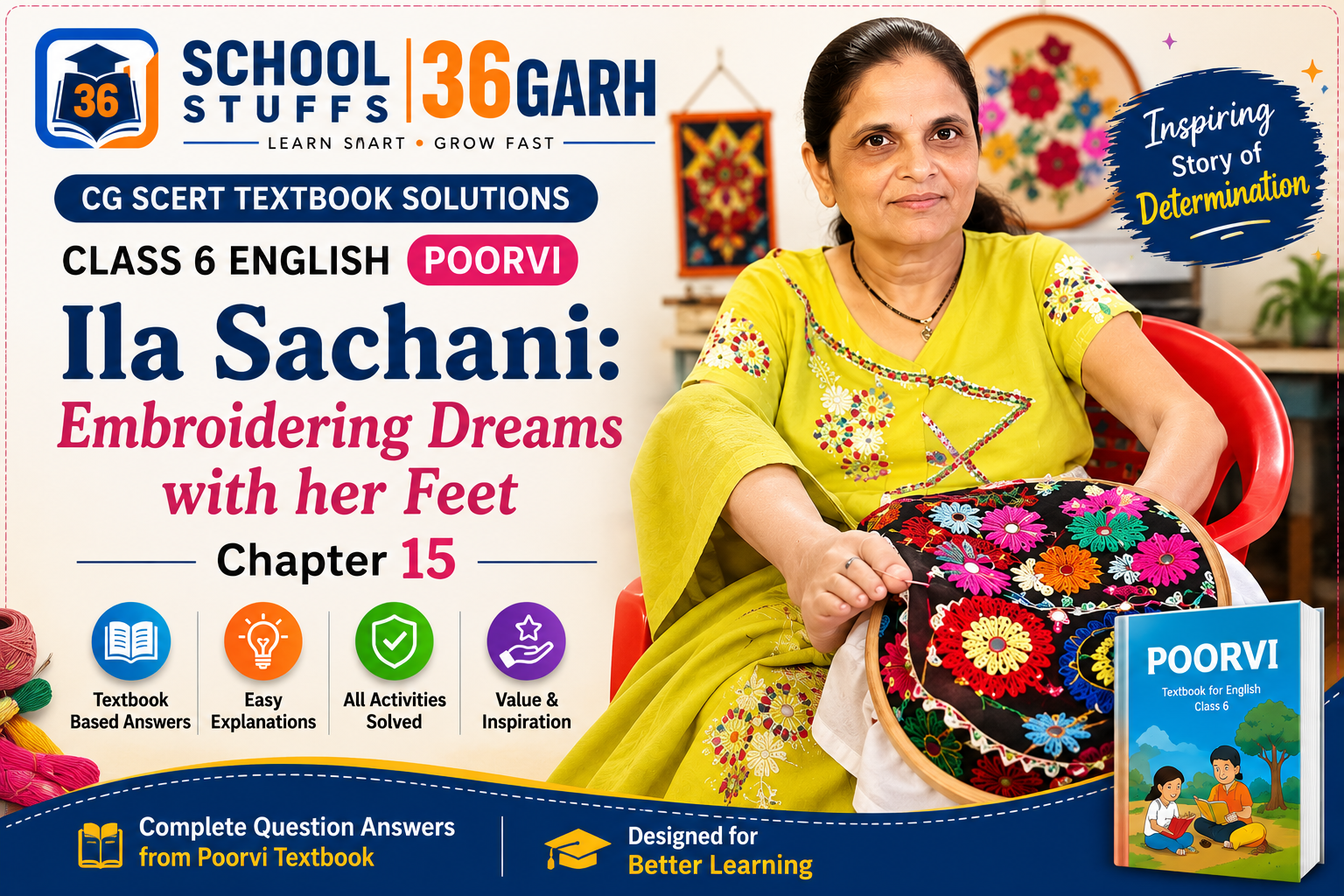
Ila Sachani Embroidering Dreams with her Feet Question Answer
🎯 Gist of the Lesson
Ila Sachani: Embroidering Dreams with her Feet is the inspiring real-life story of a talented woman from Gujarat who was born without the use of her hands. Although she faced many difficulties in childhood, her mother and grandmother encouraged her to learn the traditional art of Kathiawar embroidery using her feet. With determination, hard work, and the support of her family, Ila mastered embroidery and created beautiful designs.
Her talent gradually became known beyond her village. Her embroidery was displayed at a state exhibition, where people appreciated and purchased her work. Later, she participated in many exhibitions across India, received several awards, and earned the President’s Medal for her outstanding achievement.
The lesson teaches that physical limitations cannot stop a determined person from achieving success. It also highlights the importance of family support, self-confidence, perseverance, and a positive attitude. Ila’s journey proves that with courage and dedication, challenges can be transformed into opportunities and dreams can become reality.
✅ Summary of the Lesson
“Ila Sachani: Embroidering Dreams with her Feet” is the inspiring true story of Ila Sachani, a woman from Amreli, Gujarat, who was born with hands that she could not use. As a child, she could not perform everyday activities like other children, but her mother and grandmother encouraged her instead of losing hope. Since they were skilled in Kathiawar embroidery, they taught Ila to create beautiful embroidery using her feet.
Learning embroidery with her feet was not easy. Ila accepted the challenge with great determination and practised regularly. Her parents also helped her become independent by teaching her to do daily activities with her legs. With the support of her younger brother and sister, she became an expert in embroidery and even learned different embroidery styles such as Kachhi, Kashmiri, and Lucknawi.
Initially, Ila embroidered beautiful designs for her family and friends. Everyone admired her talent, and soon people in her village also began appreciating her work. Her remarkable skill reached the government office in Surat, where officials displayed her embroidery at a state exhibition. The exhibition brought her recognition, and many people purchased her creations.
Encouraged by her success, Ila participated in several state and national exhibitions. She received many awards and honours, including the President’s Medal, for her creativity, determination, and exceptional embroidery. Through her hard work, she became financially independent and earned respect and happiness by doing what she loved.
The lesson conveys a powerful message that determination, family support, positive thinking, and hard work can help overcome even the greatest challenges. Ila Sachani’s life teaches us that true talent and courage can rise above physical limitations and inspire others to achieve their dreams.
✅ Difficult Words (English + Hindi)
| Word | Hindi Meaning (हिंदी अर्थ) |
|---|---|
| Embroidery | कढ़ाई |
| Dream | सपना |
| Colourful | रंग-बिरंगा |
| Cushion | गद्दी |
| Bedcover | बिस्तर की चादर |
| Pillow | तकिया |
| Needle | सुई |
| Design | डिज़ाइन / आकृति |
| Skill | कौशल |
| Challenge | चुनौती |
| Farmer | किसान |
| Loose | ढीला |
| Usual | सामान्य |
| Pluck | तोड़ना |
| Encouraged | प्रोत्साहित किया |
| Single-minded | दृढ़ निश्चयी |
| Pattern | नमूना / आकृति |
| Determination | दृढ़ संकल्प |
| Threading | सुई में धागा डालना |
| Expert | विशेषज्ञ |
| Express | व्यक्त करना |
| Crafted | बनाया |
| Awestruck | आश्चर्यचकित |
| Talent | प्रतिभा |
| Admiration | प्रशंसा |
| Government | सरकार |
| Display | प्रदर्शित करना |
| Exhibition | प्रदर्शनी |
| Creation | रचना |
| Popularity | प्रसिद्धि |
| Participated | भाग लिया |
| National | राष्ट्रीय |
| Awards | पुरस्कार |
| Honours | सम्मान |
| Creativity | रचनात्मकता |
| Celebrated | प्रसिद्ध |
| Independence | आत्मनिर्भरता / स्वतंत्रता |
| Regular Income | नियमित आय |
| Victory | विजय |
| Positivity | सकारात्मकता |
| Physical | शारीरिक |
| Boundaries | सीमाएँ |
| Soul | आत्मा |
| Kathiawar | काठियावाड़ (गुजरात की पारंपरिक कढ़ाई शैली) |
| Kachhi | कच्छी कढ़ाई शैली |
| Kashmiri | कश्मीरी कढ़ाई शैली |
| Lucknawi | लखनऊ की कढ़ाई शैली |
| President’s Medal | राष्ट्रपति पदक |
✅ Let Us Do These Activities Before We Read
Activity I. Look at the given picture and information. Discuss the questions with your teacher and classmates.

1. Do you think Pranav’s task is simple? Why or why not?
Answer: No, Pranav’s task is not simple. He was born without both hands, so he has to work much harder than others. However, with determination and practice, he became an artist, a singer, and a para-sportsperson.
2. How does Pranav’s special ability make you feel?
Answer: Pranav’s special ability makes me feel inspired and motivated. His achievements show that courage and hard work can help us overcome challenges.
3. What qualities do you think were important for Pranav to become successful?
Answer: The qualities that helped Pranav become successful are:
- Determination
- Hard work
- Self-confidence
- Patience
- Positive attitude
- Never giving up
ACTIVITY II. Look at the picture of Kathiawar embroidery. Discuss in pairs.

1. List the steps you think are needed to create this embroidery.
Answer:
- Choose the cloth.
- Draw or select a design.
- Thread the needle.
- Stitch the design carefully.
- Add colours and decorative patterns.
- Finish the embroidery neatly.
2. Discuss if these steps can be done with feet, instead of hands.
Answer: Yes, these steps can be done with feet. Although it is very difficult, a determined person can learn to embroider with practice, just as Ila Sachani did.
3. What efforts would be needed if someone has to embroider with their feet? Do you think it is possible?
Answer: A person would need a lot of patience, regular practice, determination, concentration, and family support. Yes, it is possible, as Ila Sachani proved through her hard work and perseverance.
✅ Let Us Discuss
Read the paragraphs and write the main idea for each. Then, match the main idea with two supporting details.
ANSWER :
| Paragraph | Main Idea | Two Supporting Details |
|---|---|---|
| 1 | Introduction to Ila Sachani’s colourful embroidery | (i) Examples of embroidered things like cushions, bedcovers and pillows. (ii) Ila creates beautiful designs using a shiny needle and is skilled in Kathiawar embroidery. |
| 2 | Early challenges and family support | (i) Ila was born with hands that she could not use normally. (ii) She wished to do things like other children but could not. |
| 3 | Learning embroidery with the help of her family | (i) Ila’s mother and grandmother taught her Kathiawar embroidery using her feet. (ii) Her parents also helped her learn daily activities with her legs. |
| 4 | Determination and mastery of embroidery | (i) Ila practised hard and learned to thread a needle with her feet. (ii) She became an expert and learned Kachhi, Kashmiri, Lucknawi and other embroidery styles. |
| 5 | Ila’s talent becomes well known | (i) She first made beautiful designs for her family and friends. (ii) Soon, people in her village admired and appreciated her work. |
| 6 | Recognition at a state exhibition | (i) The government office in Surat displayed her embroidery at a state exhibition. (ii) Visitors admired and purchased her creations, making her famous. |
| 7 | National recognition and awards | (i) Ila participated in state and national exhibitions. (ii) She received many awards and the President’s Medal for her creativity and determination. |
| 8–9 | Success through hard work and determination | (i) Financial independence and joy. (ii) Challenges can be turned into victories through focus, hard work and a positive attitude. |
✅ Let Us Think and Reflect
I. Read the following lines and answer the questions that follow.
“Unlike other children, she could not use her hands in the usual way. While other small hands drew figures in the sand or plucked wild flowers, she wondered why she could not join them. She too wanted to hold a chalk in her hands and draw figures on a slate.”
1. Choose the correct option to fill in the blank.
‘Unlike other children’ means that Ila was different.
2. What could Ila have felt when she could not join others in things they did?
Answer: Ila could have felt sad, disappointed, and left out because she could not do the activities that other children enjoyed.
3. Complete the following with a suitable reason.
Answer: Ila could not draw figures on the slate because she could not use her hands in the usual way.
II. What creative ways did Ila and her family use to overcome the challenges she faced?
Answer: Ila’s mother and grandmother taught her the traditional art of Kathiawar embroidery using her feet. Her parents also helped her learn daily activities like eating and combing her hair with her legs. Her brother and sister encouraged and supported her while she practised embroidery.
III. How did ‘new independence’ help Ila?
Answer: New independence helped Ila earn a regular income through her embroidery. It also gave her confidence, self-reliance, and happiness because she was able to do the work she loved.
IV. Why was the first state exhibition an important event in Ila’s life?
Answer: The first state exhibition made Ila’s talent known to many people. Visitors admired and purchased her embroidery, bringing her recognition and opening new opportunities for her career.
V. What does the sentence, ‘art has the power to rise above physical boundaries and touch the soul’, tell us about the power of art?
Answer: The sentence tells us that true art is not limited by physical disabilities. It can inspire people, express emotions, and touch the hearts of others through creativity and dedication.
VI. How can we be helpful and encouraging like Ila’s family and friends when someone faces challenges?
Answer: We can support and encourage them, appreciate their efforts, help them learn new skills, treat them with kindness and respect, and motivate them to believe in themselves.
VII. How can Ila’s story help others to overcome challenges in their lives?
Answer: Ila’s story teaches us that determination, hard work, family support, and a positive attitude can help us overcome difficulties. It inspires us to never give up and to turn challenges into opportunities for success.
✅ Let Us Learn
I. Read the words from the text given in Column A. Then, try to understand what they mean by reading the sentences in Column B. Now, match the word to its
correct synonym in Column C. There are two extra synonyms given. You may refer to the dictionary.
ANSWER : Here is the correctly matched table, aligning each word from Column A with its corresponding sentence from Column B and its correct synonym from Column C:
| Column A (Word) | Column B (Sentence) | Column C (Synonym) |
| tiny | The garden was tiny but the park was really big. | small |
| wonderful | The wonderful artwork made everyone clap. | fantastic |
| quiet | The quiet library was a better place to study than the noisy classroom. | silent |
| task | Completing the Science homework was a challenging task as it had many questions. | work |
| tough | We know that tough times can be overcome, if we try sincerely. | difficult |
II. Unscramble the antonyms of the words in Column A. An example has been given for you.
Example: display – E D I H (H I D E )
| Word | Unscrambled Antonym |
|---|---|
| 1. tiny – E G H U | HUGE |
| 2. wonderful – R E E B L I T R | TERRIBLE |
| 3. quiet – I Y N S O | NOISY |
| 4. task – S I A E M T P | PASTIME |
| 5. tough – S E Y A | EASY |
III. Read the sentences from the text and focus on the highlighted words.
• You will see lots of bright colours.
• There are many lovely things like cushions and bedcovers.
• They taught her to create many beautiful patterns using her feet!
• She learned many styles.
• She received many awards.
• Encouraged by the popularity, Ila participated in more exhibitions.
• …a style that needs a lot of skill.
1. Insert the given words of quantity in the blanks.
(some, most, many, a lot of, lots of, more)
ANSWER :
I. How many of you speak English?
II. India receives a lot of rains during monsoon.
III. There were more people than I expected.
IV. Please give me some more curd.
2. Here is a list of things your mother gave you to check. Tell your mother how much/how many things are left at home.
Hints: (rice, oil, butter, salt, biscuits, pencil some, a lot of, many, lots of)
Sample Answers:
- There is some rice left.
- There is a lot of oil left.
- There is some butter left.
- There is lots of salt left.
- There are many biscuits left.
- There are some pencils left.
3. Let us now understand what words of quantity tell us. Fill in the blanks to complete an example for each word of quantity. Hints are given in the brackets. Now, create two sentences for each word of quantity (i-vi), and share them with your teacher and classmates
ANSWER :
(i) We saw many buses on the road. (countable noun)
(ii) How much milk do you want? (uncountable noun)
(iii) She picked some flowers. (countable noun)
(iv) I need more examples. (countable noun)
(v) I have a lot of energy left. (uncountable noun)
(vi) I ate some rice. (uncountable noun)
✅ Let Us Listen
You will listen to a talk about Kathiawar embroidery. As you listen, circle the correct option. (Refer to the transcript on page 157.)

Answers :
- Form
 (i) old
- Colours
- (ii) bright
- Stitches
- (ii) chain stitch
- Seen on
- (i) children’s caps
- Things used
- (i) small mirrors
- Designs
- (ii) squares and triangles
✅ Let Us Speak
In pairs, write down two questions you would like to ask Ila Sachani.
1. Look at two examples.
Where were you born?
Did you go to school?
Answer:
- Where were you born?
- How did you learn embroidery with your feet?
More Sample Questions
- What inspired you to become an embroidery artist?
- Who encouraged you the most in your life?
- Which embroidery style do you like the most?
- How did you feel when you received the President’s Medal?
- What message would you like to give to children?
- What challenges did you face while learning embroidery?
- Which was your first exhibition?
- How did your family help you achieve success?
✅ Let Us Write
- Collect four/five items (such as flowers, leaves, pins, waste paper, old cards,
cardboard boxes, straws, twigs, etc.). - Use these items to create any kind of artwork.
Now, write a paragraph describing the artwork that you have created. - Give a suitable title to your paragraph.
SAMPLE ANSWER :
My Nature Artwork
I collected a few leaves, flowers, twigs, coloured paper, and an old piece of cardboard to create my artwork. I arranged the leaves and flowers to make a beautiful tree and used the twigs to form its branches. I decorated the picture with coloured paper to make it bright and attractive. I enjoyed making this artwork because it was creative and environmentally friendly. This activity taught me that useful and beautiful things can be made from simple waste materials
✅ Let Us Explore
1. Does anyone in your family or neighbourhood do embroidery? Find out what type of embroidery they do and how they learnt it.
Sample Answer:
Yes, a woman in my neighbourhood does embroidery. She makes beautiful designs on clothes using traditional hand embroidery. She learnt this art from her mother and improved her skills through regular practice.
2. Try a simple stitch on cloth with the guidance of a family member.
Sample Answer:
I tried a simple running stitch on a piece of cloth with the guidance of a family member. It was an enjoyable learning experience and helped me understand the patience and skill required for embroidery.
3. Visit the given link to find out about embroidery types from different parts of India. Share which one you liked the most and why.
Sample Answer:
I liked Kathiawar embroidery the most because of its bright colours, beautiful patterns, and mirror work. After reading about Ila Sachani’s inspiring journey, I admire this embroidery style even more because it reflects creativity, determination, and hard work.