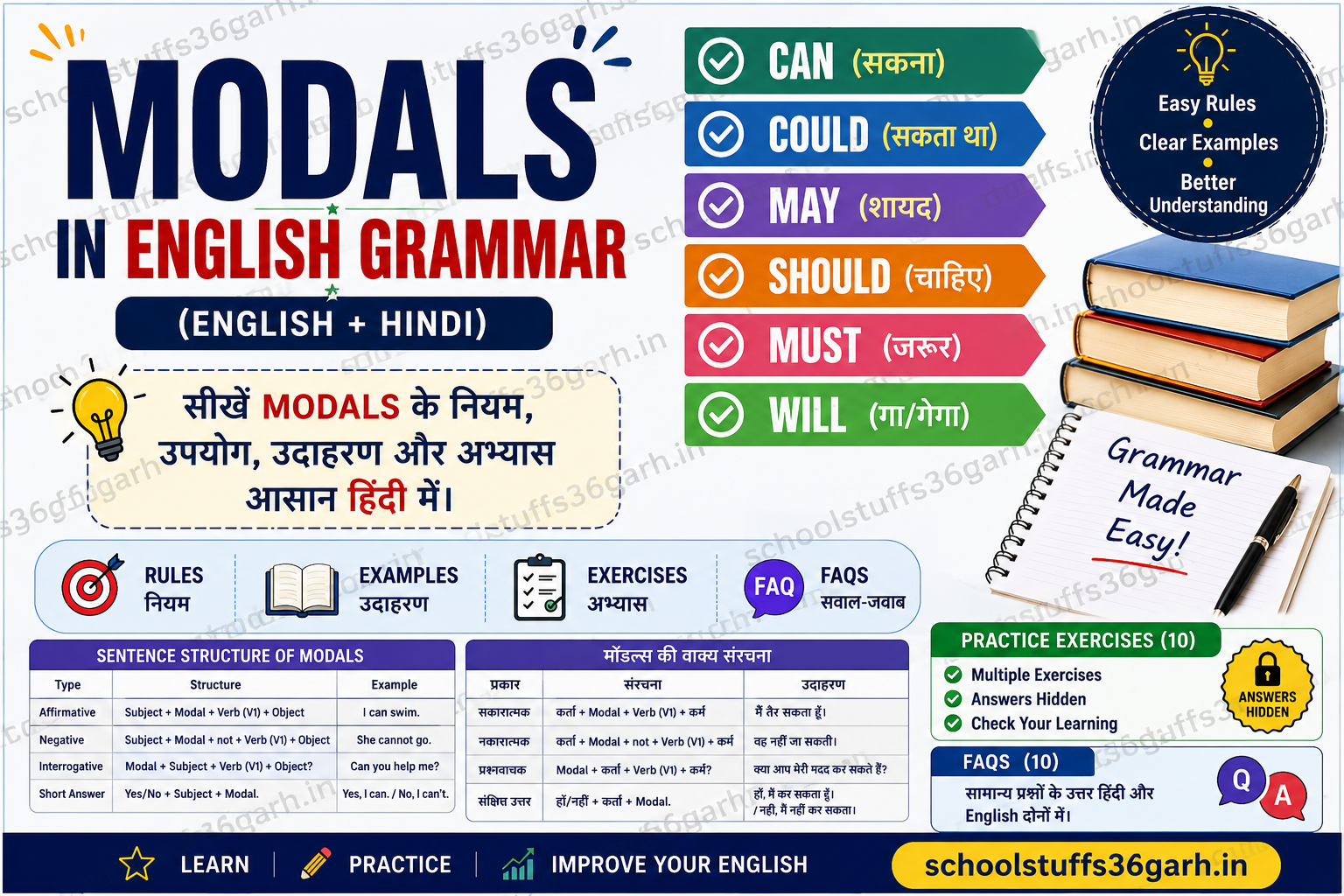
Modals of English Grammar - SCHOOL STUFFS 36GARH
Learn Modals in English Grammar with Hindi explanation, examples, rules, sentence structures and practice exercises.
What are Modals? | Modals क्या होते हैं?
Modals are helping verbs that express ability, permission, possibility, advice, necessity and obligation.
Modals ऐसे Helping Verbs होते हैं जो क्षमता, अनुमति, संभावना, सलाह और आवश्यकता को व्यक्त करते हैं।
- Can
- Could
- May
- Might
- Should
- Must
- Will
Use of CAN
Can is used to express ability, permission and possibility.
Can का उपयोग क्षमता, अनुमति और संभावना व्यक्त करने के लिए किया जाता है।
1. I can swim.
मैं तैर सकता हूँ।
2. She can dance well.
वह अच्छा नृत्य कर सकती है।
3. We can solve this question.
हम यह प्रश्न हल कर सकते हैं।
4. You can go now.
तुम अब जा सकते हो।
5. It can rain today.
आज बारिश हो सकती है।
Use of COULD
Could is used for past ability, polite request and weak possibility.
Could का उपयोग भूतकाल की क्षमता, विनम्र अनुरोध और कम संभावना व्यक्त करने के लिए किया जाता है।
1. I could swim when I was five.
मैं पाँच साल की उम्र में तैर सकता था।
2. She could speak English fluently.
वह धाराप्रवाह अंग्रेज़ी बोल सकती थी।
3. Could you help me?
क्या आप मेरी मदद कर सकते हैं?
4. He could come tomorrow.
वह कल आ सकता है।
5. We could win the match.
हम मैच जीत सकते हैं।
Use of MAY
May is used for permission and possibility.
May का उपयोग अनुमति और संभावना व्यक्त करने के लिए किया जाता है।
1. May I come in?
क्या मैं अंदर आ सकता हूँ?
2. It may rain tomorrow.
कल बारिश हो सकती है।
3. She may join us today.
वह आज हमारे साथ जुड़ सकती है।
4. You may leave now.
आप अब जा सकते हैं।
5. He may call tonight.
वह आज रात फोन कर सकता है।
Use of SHOULD
Should is used for advice and suggestion.
Should का उपयोग सलाह और सुझाव देने के लिए किया जाता है।
1. You should study hard.
तुम्हें मेहनत से पढ़ना चाहिए।
2. We should respect elders.
हमें बड़ों का सम्मान करना चाहिए।
3. He should eat healthy food.
उसे पौष्टिक भोजन खाना चाहिए।
4. Students should complete homework.
विद्यार्थियों को गृहकार्य पूरा करना चाहिए।
5. You should wake up early.
तुम्हें जल्दी उठना चाहिए।
Use of MUST
Must is used for strong necessity and obligation.
Must का उपयोग मजबूत आवश्यकता और कर्तव्य व्यक्त करने के लिए किया जाता है।
1. We must follow traffic rules.
हमें ट्रैफिक नियमों का पालन करना चाहिए।
2. You must wear uniform.
तुम्हें यूनिफॉर्म पहननी ही चाहिए।
3. Students must obey teachers.
विद्यार्थियों को शिक्षकों की बात माननी चाहिए।
4. We must save trees.
हमें पेड़ बचाने चाहिए।
5. Everyone must keep the classroom clean.
सभी को कक्षा साफ रखनी चाहिए।
Use of WILL
Will is used for future actions.
Will का उपयोग भविष्य में होने वाले कार्यों को व्यक्त करने के लिए किया जाता है।
1. I will call you tomorrow.
मैं तुम्हें कल फोन करूँगा।
2. She will visit Delhi next week.
वह अगले सप्ताह दिल्ली जाएगी।
3. We will win the match.
हम मैच जीतेंगे।
4. They will help us.
वे हमारी मदद करेंगे।
5. He will arrive soon.
वह जल्द पहुँचेगा।
Sentence Structure of Modals | Modals के वाक्य संरचना
नीचे Modals के Positive, Negative और Interrogative sentence structures दिए गए हैं।
| Type | प्रकार | Structure | संरचना | Example | उदाहरण |
|---|---|---|
| Positive | Subject + Modal + V1 | She can dance. |
| Negative | Subject + Modal + not + V1 | He cannot swim. |
| Interrogative | Modal + Subject + V1? | Can you drive? |
Difference Between Can and May
| Can | May |
|---|---|
| Informal Permission | Formal Permission |
| Can I go out? | May I come in? |
Practice Exercises | अभ्यास प्रश्न
1. You ______ obey your parents.
2. ______ I come in?
3. She ______ swim fast.
4. We ______ respect elders.
5. Students ______ complete homework daily.
6. It ______ rain tonight.
7. He ______ help you tomorrow.
8. You ______ wear school uniform.
9. ______ you solve this question?
10. We ______ save water.
1. should
2. May
3. can
4. should
5. should
6. may
7. will
8. must
9. Can
10. must
Frequently Asked Questions (FAQs) | अक्सर पूछे जाने वाले प्रश्न
1. What are Modals in English Grammar?
Modals are helping verbs used to express ability, permission, advice and possibility.
Modals ऐसे Helping Verbs होते हैं जो क्षमता, अनुमति, सलाह और संभावना को व्यक्त करते हैं।
2. Which are the common Modals?
Can, Could, May, Might, Should, Must and Will are common Modals.
Can, Could, May, Might, Should, Must और Will सामान्य Modals हैं।
3. What is the use of Can?
Can is used to express ability and permission.
Can का उपयोग क्षमता और अनुमति व्यक्त करने के लिए किया जाता है।
4. What is the difference between Can and May?
Can is informal while May is more formal.
Can अनौपचारिक होता है जबकि May अधिक औपचारिक होता है।
5. Why do we use Should?
Should is used for advice and suggestion.
Should का उपयोग सलाह और सुझाव देने के लिए किया जाता है।
6. What is the use of Must?
Must is used for strong necessity and obligation.
Must का उपयोग मजबूत आवश्यकता और कर्तव्य व्यक्त करने के लिए किया जाता है।
7. Can Modals change form?
No, most Modals do not change according to subject.
नहीं, अधिकांश Modals subject के अनुसार नहीं बदलते।
8. Which verb form comes after Modals?
The base form of verb (V1) comes after Modals.
Modals के बाद Verb की पहली form (V1) आती है।
9. Are Modals important in spoken English?
Yes, Modals are very important for spoken and written English.
हाँ, Modals spoken और written English दोनों में बहुत महत्वपूर्ण हैं।
10. How can students improve Modals?
Students can improve Modals by practicing sentences daily.
विद्यार्थी रोज़ sentence practice करके Modals बेहतर कर सकते हैं।
Conclusion | निष्कर्ष
Modals English Grammar का एक महत्वपूर्ण भाग हैं। इनके सही प्रयोग से विद्यार्थी English speaking और writing skills को बेहतर बना सकते हैं।