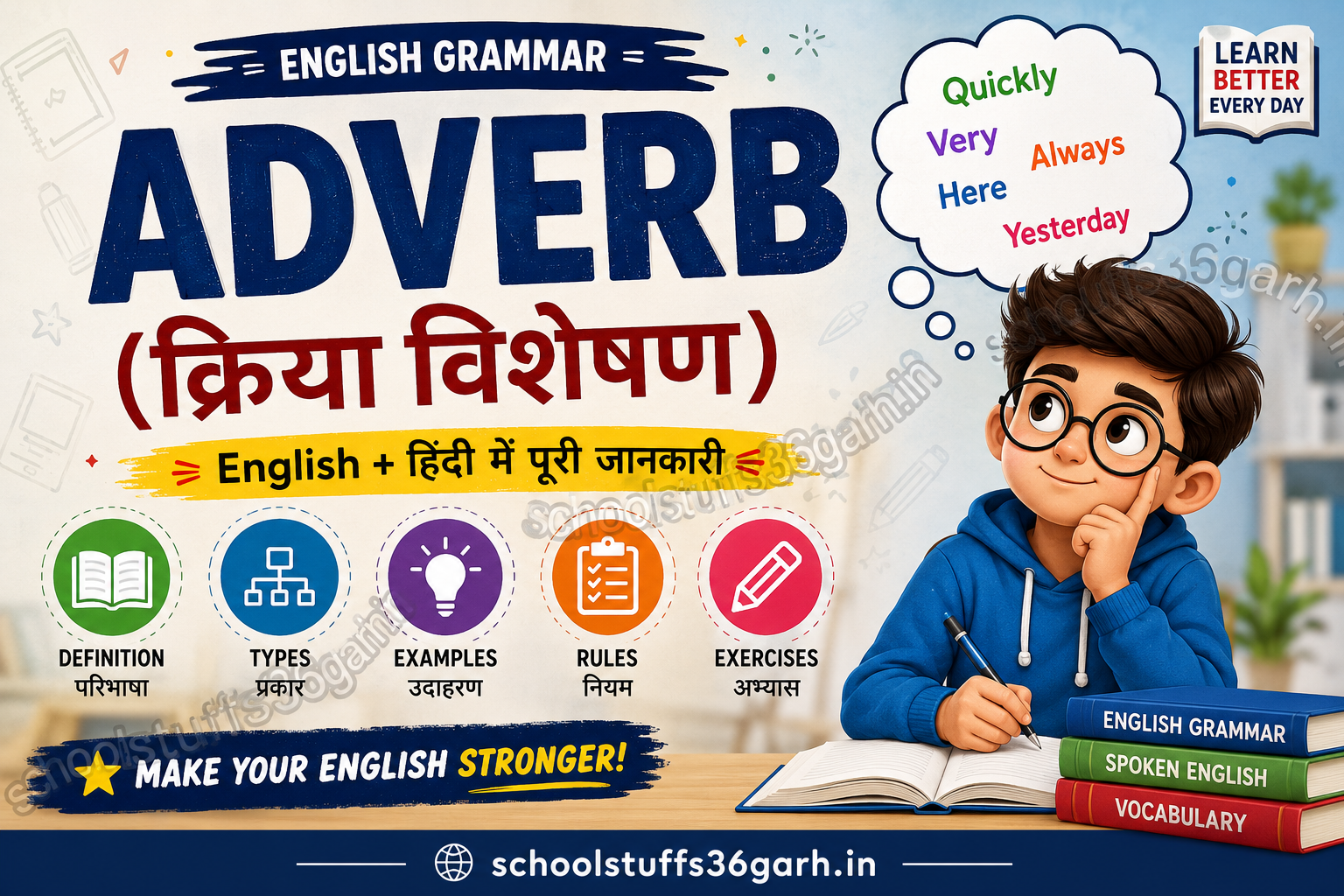
Adverb in English Grammar
क्रिया विशेषण (Adverb) को आसान हिंदी + English में सीखें
What is an Adverb? | Adverb क्या होता है?
An Adverb is a word that tells us more about a verb, adjective, or another adverb.
Adverb वह शब्द होता है जो Verb (क्रिया), Adjective (विशेषण) या किसी दूसरे Adverb के बारे में अतिरिक्त जानकारी देता है।
Example:
Ram runs fast.
राम तेज़ दौड़ता है।
She is very beautiful.
वह बहुत सुंदर है।
Types of Adverbs | Adverb के प्रकार
1. Adverb of Manner
This tells us how an action happens.
यह बताता है कि कार्य कैसे हो रहा है।
Examples:
1. He writes neatly.
वह साफ-साफ लिखता है।
2. The teacher explained clearly.
शिक्षक ने स्पष्ट रूप से समझाया।
3. She danced beautifully.
वह सुंदर तरीके से नाची।
4. The baby cried loudly.
बच्चा जोर से रोया।
5. Rahul completed the work quickly.
राहुल ने काम जल्दी पूरा किया।
2. Adverb of Time
This tells us when something happens.
यह बताता है कि कार्य कब हुआ।
Examples:
1. I will come tomorrow.
मैं कल आऊँगा।
2. She arrived early.
वह जल्दी पहुँची।
3. We met yesterday.
हम कल मिले थे।
4. He is leaving now.
वह अभी जा रहा है।
5. The train will arrive soon.
ट्रेन जल्द आएगी।
3. Adverb of Place
This tells us where the action happens.
यह बताता है कि कार्य कहाँ हो रहा है।
Examples:
1. Come here.
यहाँ आओ।
2. The children are playing outside.
बच्चे बाहर खेल रहे हैं।
3. My bag is there.
मेरा बैग वहाँ है।
4. The dog is inside.
कुत्ता अंदर है।
5. Birds are flying everywhere.
पक्षी हर जगह उड़ रहे हैं।
4. Adverb of Frequency
This tells us how often an action happens.
यह बताता है कि कार्य कितनी बार होता है।
Examples:
1. He always helps me.
वह हमेशा मेरी मदद करता है।
2. We sometimes watch movies.
हम कभी-कभी फिल्में देखते हैं।
3. She never tells lies.
वह कभी झूठ नहीं बोलती।
4. I often visit my grandmother.
मैं अक्सर अपनी दादी से मिलने जाता हूँ।
5. They usually play cricket in the evening.
वे आमतौर पर शाम को क्रिकेट खेलते हैं।
5. Adverb of Degree
This tells us the intensity or degree.
यह मात्रा या स्तर को बताता है।
Examples:
1. She is very intelligent.
वह बहुत बुद्धिमान है।
2. The water is too hot.
पानी बहुत ज्यादा गर्म है।
3. I am quite happy today.
मैं आज काफी खुश हूँ।
4. He almost finished the race.
उसने लगभग दौड़ पूरी कर ली।
5. This bag is enough for the trip.
यह बैग यात्रा के लिए पर्याप्त है।
Formation of Adverbs
Many adverbs are formed by adding -ly to adjectives.
कई Adverbs, Adjectives में -ly जोड़कर बनाए जाते हैं।
| Adjective | Adverb |
|---|---|
| Quick | Quickly |
| Slow | Slowly |
| Happy | Happily |
| Careful | Carefully |
Easy Trick to Identify Adverbs
- How? (कैसे?)
- When? (कब?)
- Where? (कहाँ?)
- How often? (कितनी बार?)
- To what extent? (कितना?)
Practice Exercise | अभ्यास प्रश्न
1. The boy runs ________.
2. She will come ________.
3. Birds are flying ________.
4. I ________ drink tea in the morning.
5. The baby cried ________.
6. We met him ________.
7. He solved the question ________.
8. They are waiting ________.
9. She is ________ beautiful.
10. The dog barked ________.
Show Answers | उत्तर देखें
1. quickly
2. tomorrow
3. high
4. always
5. loudly
6. yesterday
7. easily
8. outside
9. very
10. angrily
Difference Between Adjective and Adverb
| Adjective | Adverb |
|---|---|
| Describes noun/pronoun | Describes verb/adjective/adverb |
| He is a fast runner. | He runs fast. |
Conclusion | निष्कर्ष
Adverbs make sentences more meaningful and expressive. They help us understand how, when, where, and how often actions happen.
Adverb वाक्यों को अधिक स्पष्ट और प्रभावशाली बनाते हैं। इनके माध्यम से हमें किसी कार्य के होने का तरीका, समय, स्थान और मात्रा पता चलती है।