Homophones in English Grammar: Meaning, Rules, Examples & Exercises (Bilingual)
What are Homophones? | Homophones क्या होते हैं?
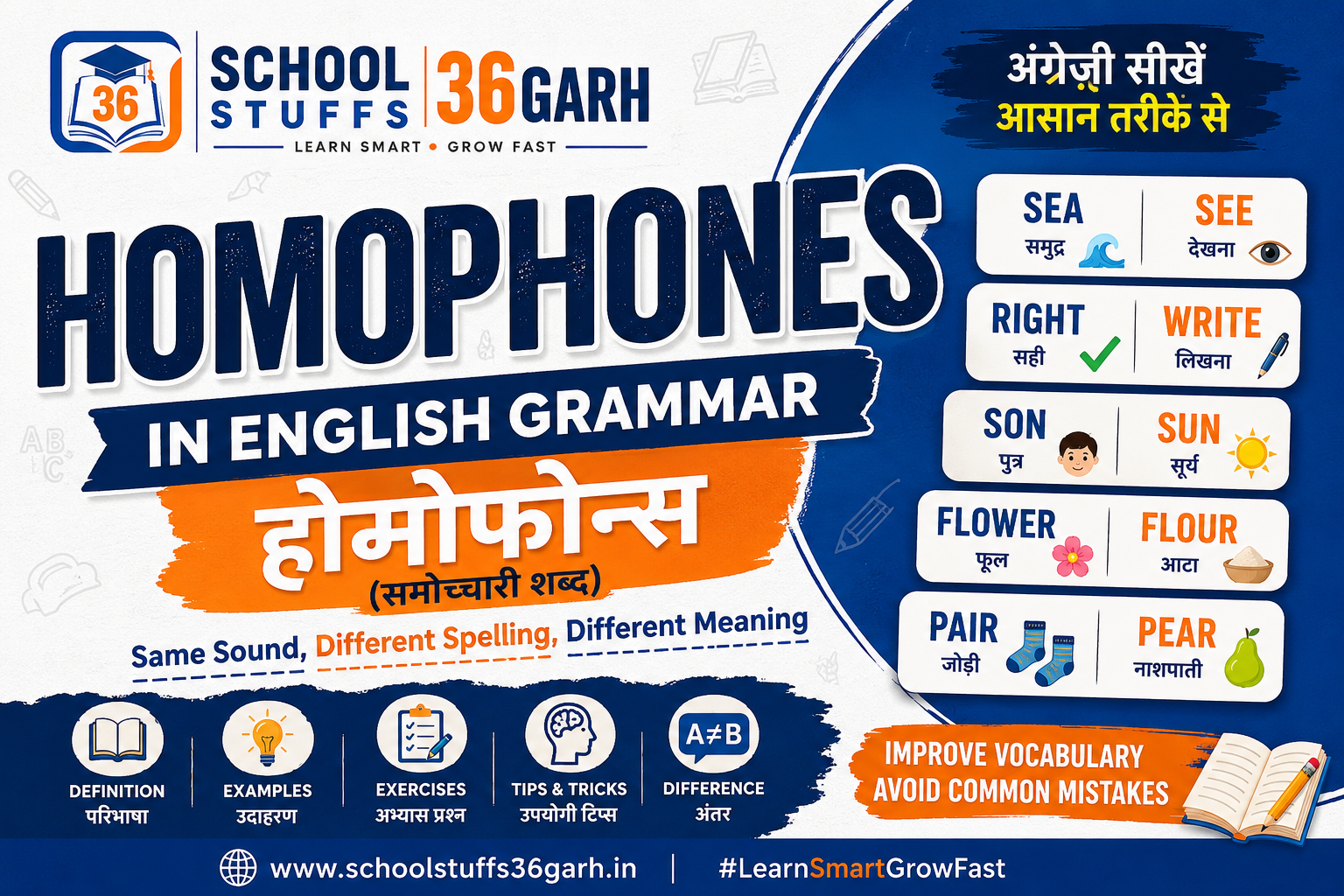
Homophones are words that have the same pronunciation but different spellings and different meanings.
Homophones (होमोफोन्स) ऐसे शब्द होते हैं जिनका उच्चारण (Pronunciation) एक जैसा होता है, लेकिन वर्तनी (Spelling) और अर्थ (Meaning) अलग-अलग होते हैं।
Remember: Same Sound + Different Spelling + Different Meaning = Homophones
Why are Homophones Important? | होमोफोन्स क्यों महत्वपूर्ण हैं?
Homophones are important because they help students:
- Improve spelling skills.
- Understand vocabulary better.
- Avoid common writing mistakes.
- Read and write English correctly.
- Score better in grammar-based examinations.
होमोफोन्स क्यों महत्वपूर्ण हैं?
होमोफोन्स सीखने से विद्यार्थी:
- सही स्पेलिंग लिखना सीखते हैं।
- शब्दों का सही अर्थ समझते हैं।
- लिखने की सामान्य गलतियों से बचते हैं।
- अंग्रेज़ी पढ़ने और लिखने में निपुण होते हैं।
- प्रतियोगी परीक्षाओं में बेहतर प्रदर्शन करते हैं।
Examples of Homophones | होमोफोन्स के उदाहरण
| Word 1 | Meaning | Word 2 | Meaning |
|---|---|---|---|
| Sea | समुद्र | See | देखना |
| Right | सही | Write | लिखना |
| Son | पुत्र | Sun | सूर्य |
| Flower | फूल | Flour | आटा |
| Pair | जोड़ी | Pear | नाशपाती |
| One | एक | Won | जीता |
| Hour | घंटा | Our | हमारा |
| Weak | कमजोर | Week | सप्ताह |
| Meet | मिलना | Meat | मांस |
| Peace | शांति | Piece | टुकड़ा |
Understanding Through Examples
1. Sea – See
Sea means a large body of salt water.
We visited the sea during summer.
See means to look at something.
I can see a rainbow.
हिन्दी – Sea = समुद्र, See = देखना
2. Right – Write
Right means correct.
Your answer is right.
Write means to put words on paper.
Please write your name.
हिन्दी – Right = सही, Write = लिखना
1. Sea – See
Sea means a large body of salt water.
We visited the sea during summer.
See means to look at something.
I can see a rainbow.
हिन्दी – Sea = समुद्र, See = देखना
2. Right – Write
Right means correct.
Your answer is right.
Write means to put words on paper.
Please write your name.
हिन्दी – Right = सही, Write = लिखना
3. Son – Sun
Son means a male child.
My son is ten years old.
Sun means the star that gives us light.
The sun rises in the east.
हिन्दी – Son = बेटा, Sun = सूरज
4. Flower – Flour
Flower
She picked a beautiful flower.
Flour
Mother bought wheat flour.
हिन्दी – Flower = फूल, Flour = आटा
5. Pair – Pear
Pair
I bought a pair of shoes.
Pear
A pear is a juicy fruit.
हिन्दी – Pair = जोड़ी, Pear = नाशपाती
More Common Homophones
| Word | Meaning | Homophone | Meaning |
|---|---|---|---|
| Brake | वाहन रोकना | Break | तोड़ना |
| Buy | खरीदना | By | द्वारा / पास |
| Cell | कोशिका | Sell | बेचना |
| Dear | प्रिय | Deer | हिरण |
| Hair | बाल | Hare | खरगोश |
| Hole | छेद | Whole | पूरा |
| डाक | Male | पुरुष | |
| डाक | Male | नर | |
| New | नया | Knew | जानता था |
| Night | रात | Knight | योद्धा |
| No | नहीं | Know | जानना |
| Road | सड़क | Rode | सवारी की |
| Tail | पूँछ | Tale | कहानी |
| Wait | प्रतीक्षा करना | Weight | वजन |
| Weather | मौसम | Whether | क्या / चाहे |
Commonly Confused Homophones
Their – There – They're
Their
Shows possession.
Their house is very big.
उनका
There
Shows place.
The book is there.
वहाँ
They’re
Short form of “They are.”
They’re playing football.
वे खेल रहे हैं।
To – Too – Two
To
Used before a verb or to show direction.
I want to play.
Too
Means “also” or “very.”
I want to play too.
Two
Number 2.
I have two books.
Your – You're
Your
Shows possession.
Your bag is blue.
You’re
Short form of “You are.”
You’re my friend.
Its – It's
Its
Shows possession.
The dog wagged its tail.
It’s
Short form of “It is.”
It’s raining.
Homophones in Sentences
1. I can see the sea. – मैं समुद्र को देख सकता हूँ।
2. Please write the right answer. – कृपया सही उत्तर लिखिए।
3. The sun is brighter than my son’s torch. – सूर्य मेरे बेटे की टॉर्च से अधिक चमकीला है।
4. Mother bought flour and a flower. – माँ आटा और एक फूल लाई।
5. He ate a pear after buying a pair of socks. – उसने मोज़ों की एक जोड़ी खरीदने के बाद नाशपाती खाई।
Tips to Identify Homophones
- Listen carefully to pronunciation.
- Read the whole sentence.
- Understand the meaning.
- Check the spelling.
- Practice regularly.
- पूरे वाक्य को पढ़ें।
- शब्द का अर्थ समझें।
- सही स्पेलिंग पहचानें।
- उच्चारण पर ध्यान दें।
- नियमित अभ्यास करें।
Difference Between Homophones, Homonyms and Homographs
| Grammar Term | Pronunciation | Spelling | Meaning |
|---|---|---|---|
| Homophones | Same | Different | Different |
| Homographs | Different/Same | Same | Different |
| Homonyms | Same | Same | Different |
Example –
Homophone
- Sea
- See
Homograph
- Lead (guide)
- Lead (metal)
Homonym
- Bat (animal)
- Bat (sports equipment)
Classroom Practice Activities
Activity 1 - Match the homophones.
| A | B |
|---|---|
| Sea | Flower |
| Right | Sun |
| Pair | See |
| Flour | Pear |
| Son | Write |
Activity 2 - Fill in the blanks.
- I can ______ the birds. (see/sea)
- Please ______ your answer. (write/right)
- The ______ rises in the east. (sun/son)
- Mother bought wheat ______. (flower/flour)
- I have a ______ of shoes. (pair/pear)
Activity 3 - Choose the correct word.
- Their / There house is beautiful.
- I have Two / Too sisters.
- You’re / Your notebook is on the table.
- Please Wait / Weight here.
- I Know / No the answer.
Activity 4 - Choose the correct word.
- I want to (buy/by) a new pen.
- We walked by the (sea/see).
- Please (write/right) your name.
- The (knight/night) wore heavy armour.
- The (weather/whether) is pleasant today.
- I (know/no) the answer.
- The dog hurt (its/it’s) leg.
- They are going (to/too/two) school.
- The (male/mail) carrier delivered a letter.
- She told an interesting (tail/tale).
ANSWER :
ACTIVITY - 1
- Sea – See
- Right – Write
- Pair – Pear
- Flower – Flower
- Son – Sun
ACTIVITY - 2
- see
- write
- sun
- flour
- pair
ACTIVITY - 3
- Their
- Two
- Your
- Wait
- Know
ACTIVITY - 4
- buy
- sea
- write
- knight
- weather
- know
- its
- to
- tale
Common Mistakes Students Make
 I went to the see yesterday.
 I went to the sea yesterday.
Please right your answer. Please write your answer.
Your my best friend. You’re my best friend.
Their going home. They’re going home.
Learning Tips
- Learn homophones in pairs or groups.
- Read English storybooks regularly.
- Listen to English conversations to recognize similar sounds.
- Keep a personal notebook of commonly confused homophones.
- Practice writing one sentence with each word to understand the difference.
Quick Revision
Homophones have the same pronunciation. Their spellings are different. Their meanings are different. The context of the sentence helps identify the correct word.
Conclusion | निष्कर्ष
Homophones are an essential part of English grammar because they teach learners that words can sound the same while carrying completely different meanings. Mastering homophones improves spelling, vocabulary, reading comprehension, and writing accuracy. For school students, especially those in Classes 5 to 8, regular practice with examples, sentence formation, and exercises builds confidence in using the correct word in the right context.
होमोफोन्स अंग्रेज़ी व्याकरण का एक महत्वपूर्ण विषय है। इनका सही ज्ञान विद्यार्थियों को सही स्पेलिंग, शब्दों का सही अर्थ, और शुद्ध वाक्य-लेखन सीखने में मदद करता है। यदि विद्यार्थी रोज़ कुछ होमोफोन्स का अभ्यास करें और उन्हें वाक्यों में प्रयोग करें, तो उनकी अंग्रेज़ी भाषा पर अच्छी पकड़ विकसित हो जाती है।
Frequently Asked Questions (FAQs)
Q1. What are homophones?
उत्तर: Homophones are words that have the same pronunciation but different spellings and meanings.
Q2. Give five examples of homophones.
उत्तर: Sea–See, Right–Write, Son–Sun, Flower–Flour, Pair–Pear.
Q3. What is the difference between homophones and homographs?
उत्तर: Homophones have the same pronunciation but different spellings, whereas homographs have the same spelling but different meanings (and sometimes different pronunciations).
Q4. Why should students learn homophones?
उत्तर: They improve spelling, vocabulary, reading comprehension, writing accuracy, and help avoid common grammar mistakes.
Q5. How can I remember homophones easily?
उत्तर: Learn them in pairs, understand their meanings, use them in sentences, and revise them regularly through exercises.