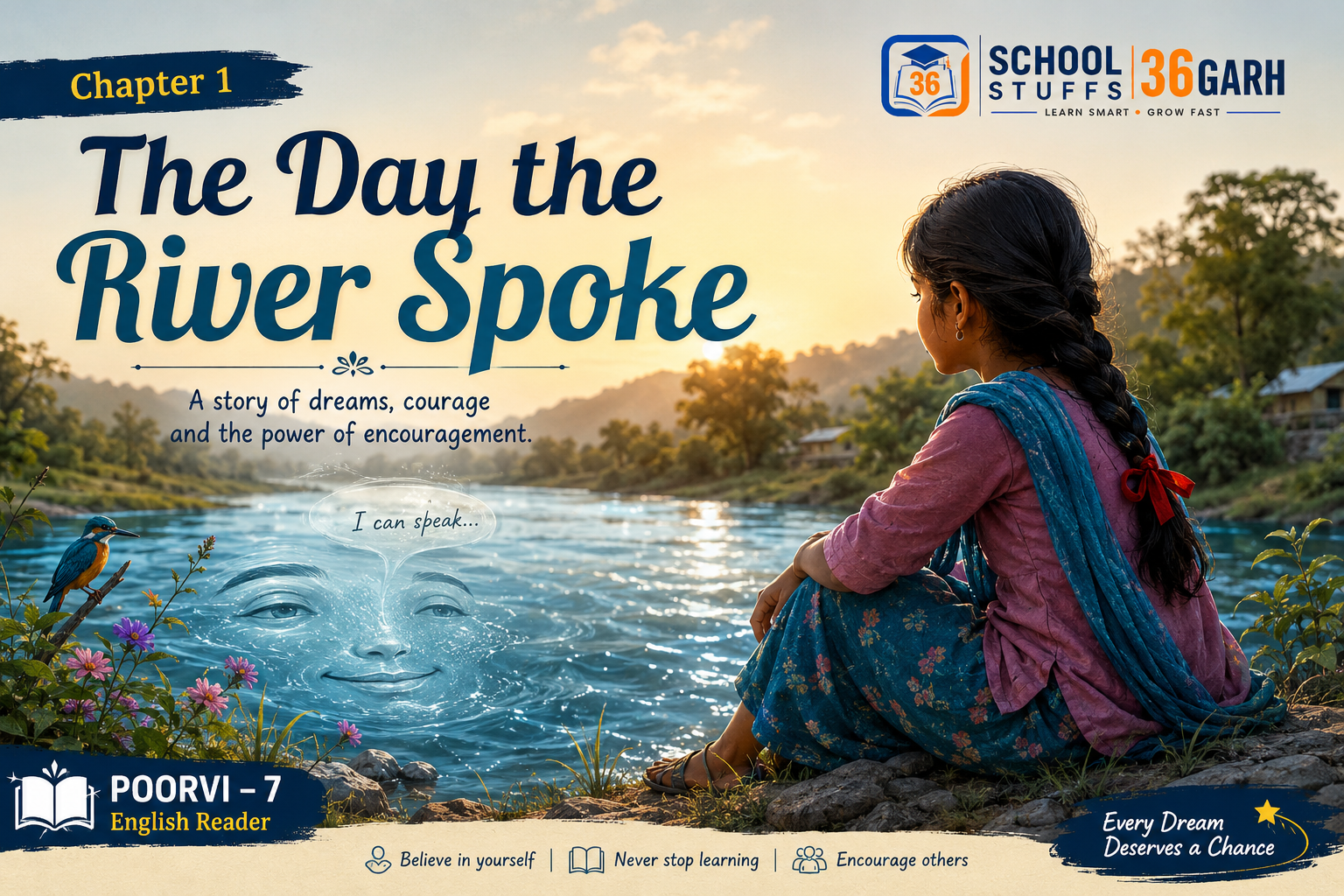
THE DAY THE RIVER SPOKE - SCHOOL STUFFS 36GARH

The Day the River Spoke CG SCERT POORVI Class 7 | Chapter 1 Questions & Answers

Get complete CG SCERT Class 7 English Chapter 1 "The Day the River Spoke" solutions, summary, character traits, and grammar answers from Poorvi textbook.

Table of Contents

The Day the River Spoke CG SCERT POORVI Class 7

Gist of the Lesson

The Day the River Spoke is a beautiful story about Jahnavi, a young village girl who dreams of going to school. One day, while sitting sadly near the river, she hears the River speaking to her. The River listens to her worries, encourages her to be brave, and inspires her to believe that girls are as capable as boys. Motivated by the River’s words, Jahnavi gathers the courage to express her wish to study. Eventually, her parents agree, and she decides that when she grows up, she will become a teacher and help other girls receive an education. The story highlights the importance of education, courage, gender equality, and respect for nature.

Summary of the Lesson

Jahnavi lives with her parents and three brothers in a coastal village. She dreams of going to school but feels afraid because girls in her village are generally not encouraged to study. One day, while crying beside the river, she is surprised to hear a gentle, sleepy voice. She soon realizes that the River itself is speaking to her.

The River comforts Jahnavi and patiently listens to her worries. During their conversation, the River tells her about the sea, ships, and the wonderful world beyond her village. More importantly, it encourages her to speak to her parents about her dream of getting an education.

Inspired by the River’s confidence in her, Jahnavi gathers courage and joins her brother at school. Her teacher speaks to her father, and with her mother’s support, Jahnavi is finally allowed to attend school. Filled with happiness, she promises that when she grows up, she will become a teacher and encourage every little girl in her village to study. The River happily invites her to return and continue listening to its stories.

The story beautifully conveys that courage, determination, and education can change lives, while nature can become a source of wisdom and inspiration.

Difficult Words (English → Hindi)

WordHindi Meaning
Splashedछपाक से गिरना
Slitheredरेंगते हुए चलना
Murmuringधीमी आवाज़ में बोलना
Baskधूप सेंकना
Thicketझाड़ियाँ / घना झुरमुट
Shriekedतीखी आवाज़ में चिल्लाना
Startledचौंक जाना
Puzzledउलझन में पड़ना
Courageसाहस
Dreamसपना
Educationशिक्षा
Coastalतटीय
Villageगाँव
Riverbankनदी का किनारा
Fishermanमछुआरा
Catamaranलकड़ियों से बनी नाव (कटमरैन)
Teacherशिक्षक
Encouragementप्रोत्साहन
Opportunityअवसर
Equalityसमानता
Scaredडरा हुआ
Whisperफुसफुसाना
Chuckleधीमे से हँसना
Squattingउकड़ूँ बैठना
Ladलड़का
Braveबहादुर
Journeyयात्रा
Seaसमुद्र
Sailपाल लगाकर चलना
Learnसीखना

Let Us Do These Activities Before We Read

Activity I – Close your eyes and quietly listen to the sounds around you for a minute. 

Q1. Are they trying to tell you something?

Sample Answer:

Yes. The sounds of birds, wind, flowing water, and rustling leaves make us feel that nature is alive. They remind us to stay calm, care for the environment, and enjoy the beauty around us.

Q2. Do you think the things around you also listen to you all day long?

Sample Answer:

Yes. Although trees, rivers, and birds cannot speak like humans, they seem to understand our feelings. Nature gives us peace and teaches us many valuable lessons.

Activity I Jahnavi was a bright young girl who lived with her parents and three brothers in a coastal village in India. Her parents worked on the farm. She had a dream.

Q1. What could that dream be?

Sample Answer: Her dream could be to go to school, receive an education, and become a teacher.

Q2. How could she make her dream come true?

Sample Answer: She could make her dream come true by:

  • speaking to her parents,
  • studying sincerely,
  • being courageous,
  • never giving up on her goal.

Q3. What is your dream? What can you do to make your dream come true?

Sample Answer: My dream is to become a scientist. I can achieve my dream by studying regularly, working hard, learning new things every day, and believing in myself.

Let Us Discuss

Q1. What was Jahnavi’s dream? Was it important to her? Why?

Answer: Jahnavi’s dream was to go to school and learn to read like her brother Ettan and Meena. It was very important to her because she had a strong desire to learn and understand the secrets of nature (like why spiders are yellow or why frogs develop from tiny fish).

Q2. Do you think the river can help her in fulfilling her dream? How?

Answer: Yes. The river helped her by encouraging her, building her confidence, and advising her to take the first step by quietly slipping into the classroom.

3. Complete the table given below with Jahnavi’s questions in Column 1 and the River’s answers in Column 2. Check your answers with the teacher
Answer :

Column I – Jahnavi’s QuestionsColumn II -River’s Answers
Can little girls do as much as little boys?Yes. Little girls can do as much as little boys.
What are ships like?They are big boats that can carry hundreds of people and sail on the sea with lights shining all night.
Will they come here?No. They cannot come here because the river is too small and shallow for such big ships.


Let Us Think and Reflect

I Read the extracts given below and answer the questions that follow.

1. “You shouldn’t cry, you know,” the voice went on. “And you really
shouldn’t be scared, when you have been coming here to see me every
day, well, almost every day.” She was puzzled. It was such a voice,
like the river. It couldn’t be the river! “Well, tell me all about it,” said
the River, for it was the River. “I’ve got to hurry to reach the sea, you
know.”
(i) Complete the sentence with the correct option from those given in the brackets.
Answer :The tone of the River in the given extract is assuring.(assuring/sympathising)

(ii) Select a phrase from the extract which shows that Jahnavi was a frequent visitor to the spot.
Answer : “coming here to see me every day, well, almost every day”

(iii) Choose the correct option to complete the sentence. 
Answer :The use of an exclamation mark at the end of the line, ‘It couldn’t be the river!’ expresses D. disbelief.

(iv) Choose three qualities of the River highlighted in the extract from the words in the box given below.
affectionate, forgiving, thoughtful, impatient, kind-hearted.
Answer : affectionate, thoughtful, kind-hearted

2. “Can I do something?” asked Jahnavi. “Well, it’s up to you,” said the
River. “Seems to me little girls can do as much as little boys—they swim
as fast as little boys. You just slip along one morning and sit there in
the school and listen to what’s going on, and maybe the teacher will let
you stay.”
“I couldn’t,” gasped Jahnavi. “I couldn’t! They’d scare me! They’d chase
me out.”

(i) Complete the sentence with an appropriate reason. According to the River, there was no difference between girls and boys because __________________.
Answer : 
According to the River, there was no difference because girls can swim as fast as boys and do as much as boys do.

(ii) Identify whether the following statement is true or false. The River encourages Jahnavi to have faith in herself and fulfill her desire to go to school.
Answer : TRUE
(iii) Choose the correct option to complete the sentence. When the River suggests that Jahnavi should ‘slip along’, it means that she should move __________________. A. quickly B. casually C. quietly D. confidently
Answer : 
When the River suggests that Jahnavi should ‘slip along’, it means that she should move quietly.

(iv) What does the repetition of the phrase I couldn’t, tell us?
Answer: 
It tells us that Jahnavi was frightened and lacked confidence about going to school.

II. Answer the Following Questions.

1. Why does the writer describe different aspects of nature in great detail at the beginning of the story? Why do you think the writer does this?
Answer: The writer describes nature in detail to create the setting of the story and to prepare the reader for the conversation between Jahnavi and the River.

2. How did the River know so much about Jahnavi?
Answer: The River knew about Jahnavi because she came to the river almost every day and the River had watched and listened to her.

3. Jahnavi says,
“And I’m so old now, they’ll never let me go.” What can you infer about Jahnavi and the school from this line?
Answer: It shows that Jahnavi had not been admitted to school earlier and she believed she had become too old to begin going to school.

4. Why did the River laugh when Jahnavi said she would be scared at school?
Answer: The River laughed because it believed Jahnavi was brave enough and should not be afraid of going to school.

5. Why should Jahnavi follow the River’s advice?
Answer: She should follow the River’s advice because it would help her fulfil her wish of going to school and getting an education.

6. How does the conversation between Jahnavi and the River make the story more appealing?
Answer: The conversation makes the story interesting and imaginative because the River speaks to Jahnavi and encourages her.

7. What is the main message that the writer intends to convey?
Answer: The story conveys that girls and boys are equally capable, and every child should have the opportunity to receive an education.

Let us learn (Grammar & Vocabulary)

I. You have learnt that naming words are called nouns and only proper nouns begin with a capital letter. Why has the author used a capital letter for the ‘River’ even when it is a common noun?
(Clue: Has the River been given qualities of a human being?)

Answer : The author capitalised ‘River’ because it is personified as a character who talks and gives advice like a human.

II. There are a few words related to sound in the text. Pick the words from the text and write them next to the correct definition.

Answer :

DefinitionWord from the text
1. made a high-pitched piercing soundshrieked
2. to cause liquid to strike or fall on somethingsplashed
3. a low continuous background noisemurmur
4. cry with loud uncontrollable gaspssobbed
5. to make a soft dry sound, like paper or leaves movingrustled
6. took a short quick breath through the mouth due to surprise, pain or shockgasped
7. shaking rapidly to make continuous short, sharp soundsrattling
8. making a lot of noisenoisy
9. made a long, high cry, usually because of pain or sadnesswailed

Now, fill in the blanks with suitable sound words from exercise (II).

ANSWER :
The classroom grew (i) quiet as the students noticed the teacher carrying the answer papers. As the teacher turned the pages with a (ii) rustle, the children (iii) gasped wondering what comments awaited. Someone (iv) wailed in frustration, and the (v) murmuring of the students steadily increased. Finally, when the teacher praised the students, they (vi) shrieked with excitement.

III. The word ‘catamaran’ is used in the text. The word originates from Tamil language ‘kattu maram’ meaning ‘tied wood’.
Find out the meanings of these words. From which Indian language these words were borrowed. An example has been given.

1. karma (Sanskrit) 2. sahib 3. chutney 4. guru 5. verandah 6. jungle 7. areca 8. palanquin
ANSWER :

  • karma — Sanskrit
  • sahib — Hindi / Urdu
  • chutney — Hindi
  • guru — Sanskrit
  • verandah — Hindi
  • jungle — Hindi / Sanskrit
  • areca — Kannada / Malayalam
  • palanquin — Sanskrit

IV.Chandu, the fisherman, has a catamaran that the River preferred to a ship. Given below are some boats that are used in different parts of our country.

(i) Which one would you like to travel in?
ANSER : I would like to travel in SHIKARA. 

V.Solve the crossword puzzle based on words related to water transport.

Across
1. a large vessel used for transporting goods or passengers by sea
2. a small vessel for travelling on water, typically propelled by oars, sails, or an engine
3. a flat floating structure for travelling across water
4. a boat or ship driven by steam
Down
5. a small, light, narrow boat, pointed at both ends and moved using a paddle
6. a boat with a powerful engine which can change direction easily and is used to pull large ships into and out of port
7. a boat with sails and sometimes an engine, used for either racing or travelling for pleasure, rhymes with ‘cot’

ANSWER :

VI.Read the highlighted words in the following lines from the text. 

“She goes down towards the sea. I’ve seen her; she always takes the same way—over the mountains and down to the sea, like me!”
Now, fill in the blanks with suitable prepositions given within the brackets.

ANSWER :
Jahnavi takes the River’s advice and goes to school. On her first day at school, Jahnavi stood nervously outside the gate, clutching her bag close to her. The bell rang and she hurried inside the bustling classroom. She found a seat between two friendly classmates. The teacher greeted them warmly and started the lesson  about numbers. Jahnavi listened attentively, feeling excited about the new adventure ahead.

VII. Fill in the blanks with prepositions or adverbs. 
ANSWER :

  • The cat jumped onto the table. (Preposition)
  • The children played outside until dark. (Adverb)
  • She quickly ran through the park. (Preposition)
  • The helicopter was hovering above. (Adverb)
  • We were just walking along chatting. (Adverb)
  • After thoroughly wiping his shoes, he stepped inside. (Adverb)
  • She drove slowly around the sharp curve. (Preposition)
  • He placed the keys under the mat before leaving. (Preposition)

  • He placed the keys under the mat before leaving. (Preposition)

WHAT IS "PREPOSITION".

Prepositions are words that indicate the relationship between nouns or pronouns and other elements in a sentence. They show direction, location, time or logical relationships between ideas.

Let us listen


I. Read the words given in the box below.

You will listen to five people speak about school life. As you listen, circle the words that are used by the speakers. There are two words you do not need. ( Visit Transcript Page  for the teacher on pg. 39 ) 

“lawyer, desks, homemaker, principal, posters, newspapers, marriage, advertisements, careers, books.”
ANSWER : The two words that are not needed / not used are lawyer and advertisements.

II. You will once again listen to the five speakers. As you listen, match each statement 1–7 to each speaker (i)–(v). There are two statements that you do not need.

ANSWER :

No.StatementSpeaker No.
1Promotes active participation for all in school activitiesSpeaker 5
2Believes in the power of education that leads to freedom of choiceSpeaker 1
3Shares that school also means companionshipSpeaker 4
4Persuades the parent to grant permission to attend schoolSpeaker 2
5Believes that learning skills is not gender-basedSpeaker 3

Unused / Extra Statements:

  • Statement 2: Comments on how school makes learning Mathematics joyful

  • Statement 5: Understands that boys and girls have different abilities


ज्ञान बांटने से बढ़ता है, शेयर करें! - Share the article

आपको यह पोस्ट कैसी लगी? कोई सवाल या सुझाव? यहाँ लिखें

Leave a Comment

RELATED ARTICLES

QR Code
Scroll to Top