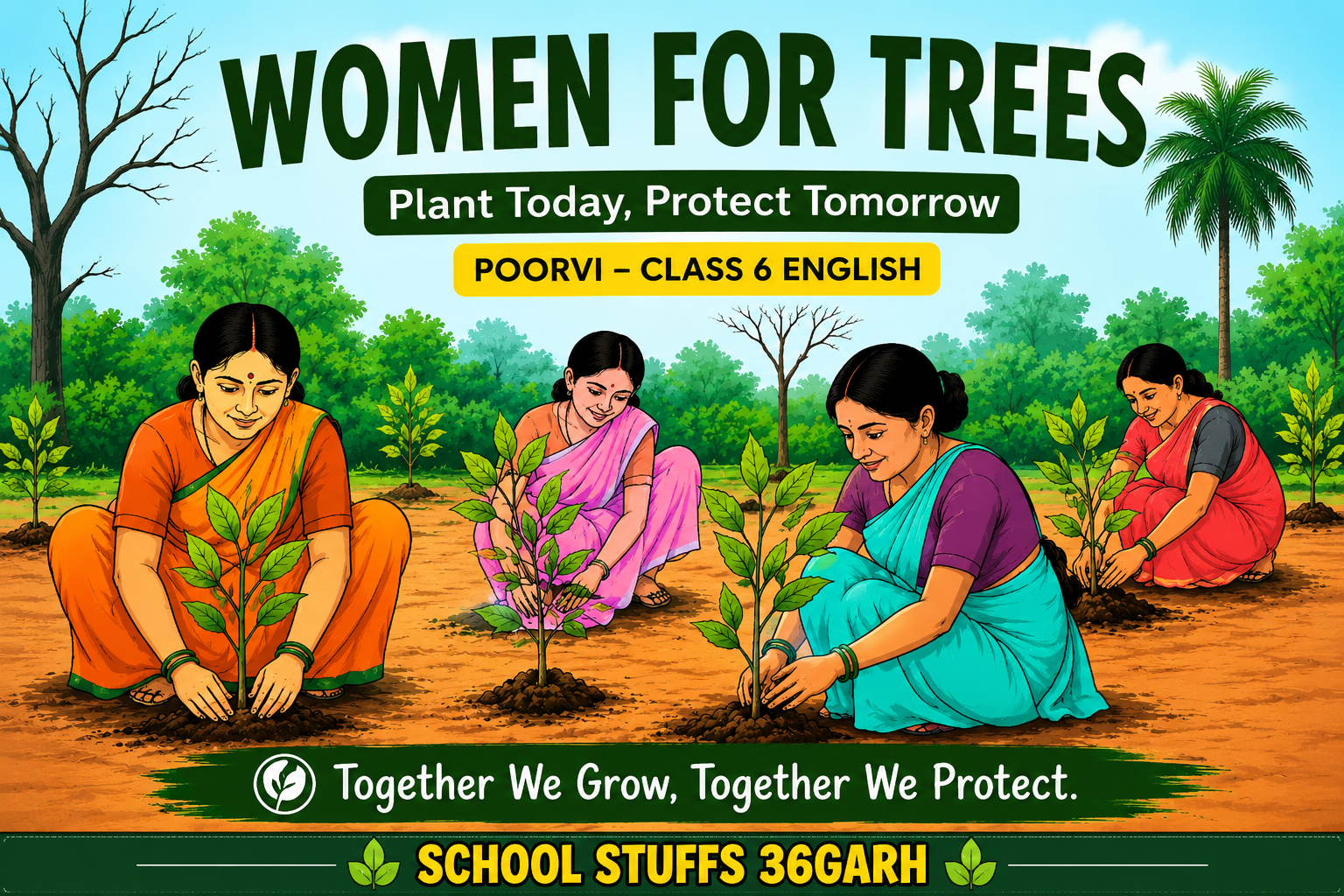
🌳 Women for Trees
Complete Notes, Questions and Answers | CG Poorvi English Class 6
📘 1. Gist of the Lesson
The lesson teaches us how brave women protected trees and forests from being cut down. It highlights the importance of nature and environmental protection. Facing a severe firewood shortage in the mid-1980s, Dalit and Adivasi women in the village of Bhalapur, Chhattisgarh, successfully regenerated 12 hectares of deforested land. Organized into a Mahila Mandal, the women dug protective trenches and actively guarded the land against poachers and the timber mafia, allowing felled tree stumps to naturally sprout back into a dense forest.
📝 2. Summary Of The Lesson
In the mid-1980s, the women of Bhalapur village in Chhattisgarh formed a Mahila Mandal to address their community's severe firewood shortage caused by rampant deforestation. Taking matters into their own hands, they reclaimed a 12-hectare plot of barren land filled with felled tree stumps. By digging protective trenches and actively guarding the area against grazing animals and the timber mafia, the women allowed the stumps to naturally regenerate.
Today, their ongoing efforts, which later included active plantation, have resulted in a dense, biodiverse forest that sustainably meets the village's firewood needs. This successful community-driven initiative inspired even its initial critics, proving a vital lesson: empowering local residents and addressing their immediate needs is far more effective for forest conservation than relying solely on large-scale, well-funded external projects.
📚 3. Difficult Words
| Word | Hindi Meaning |
|---|---|
| Forest | जंगल |
| Protect | सुरक्षा करना |
| Environment | पर्यावरण |
| Courage | साहस |
🎯 4. Let Us Do These Activities Before We Read
💬 5. Let Us Discuss
a) Decreasing b) Increasing
c) Expanding d) Improving
(a) group safeguarding tree (b) group illegally cutting trees
(c) group of wood traders
🤔 6. Let Us Think and Reflect
📖 7. Let Us Learn
Example: Ravi went to jungle to collect wood on Monday.
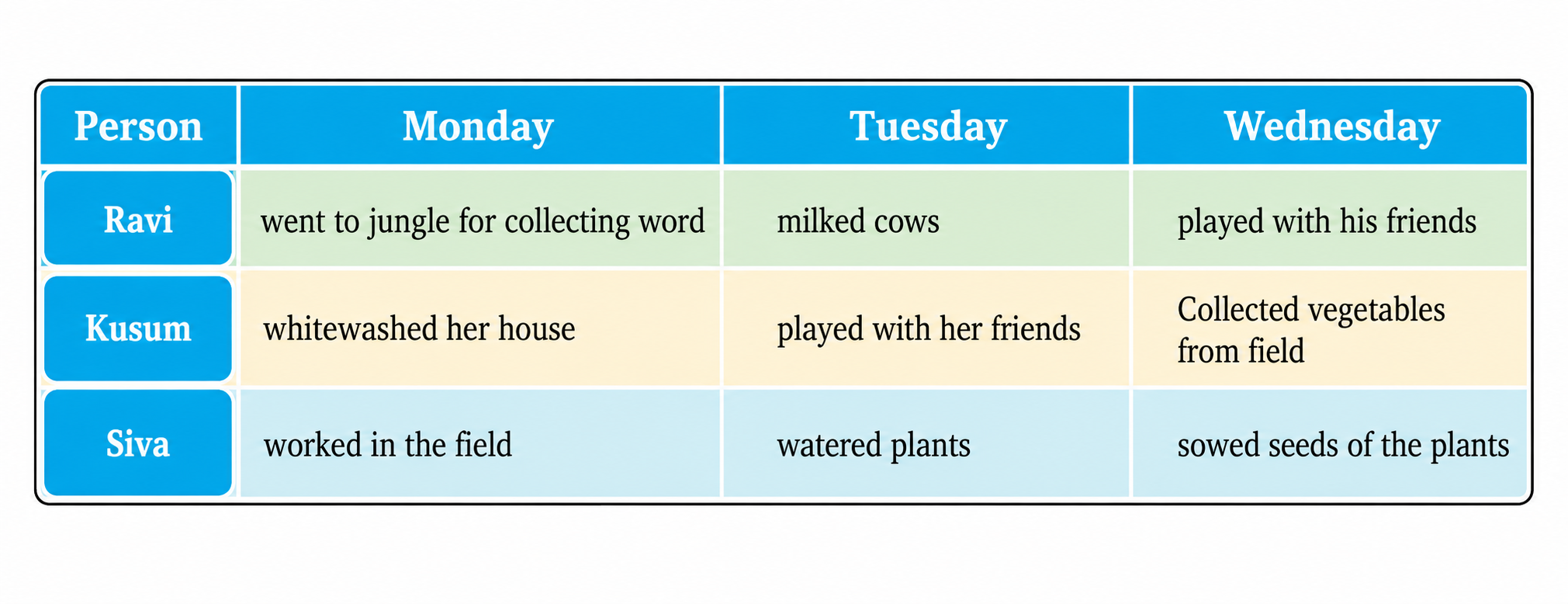
| Person | Monday | Tuesday | Wednesday |
|---|---|---|---|
| Ravi | Ravi went to jungle to collect wood on Monday. | Ravi milked cows on Tuesday. | Ravi played with his friends on Wednesday. |
| Kusum | Kusum whitewashed her house on Monday. | Kusum played with her friends on Tuesday. | Kusum collected vegetables from the field on Wednesday. |
| Siva | Siva worked in the field on Monday. | Siva watered the plants on Tuesday. | Siva sowed seeds of the plants on Wednesday. |
🎧 8. Let Us Listen
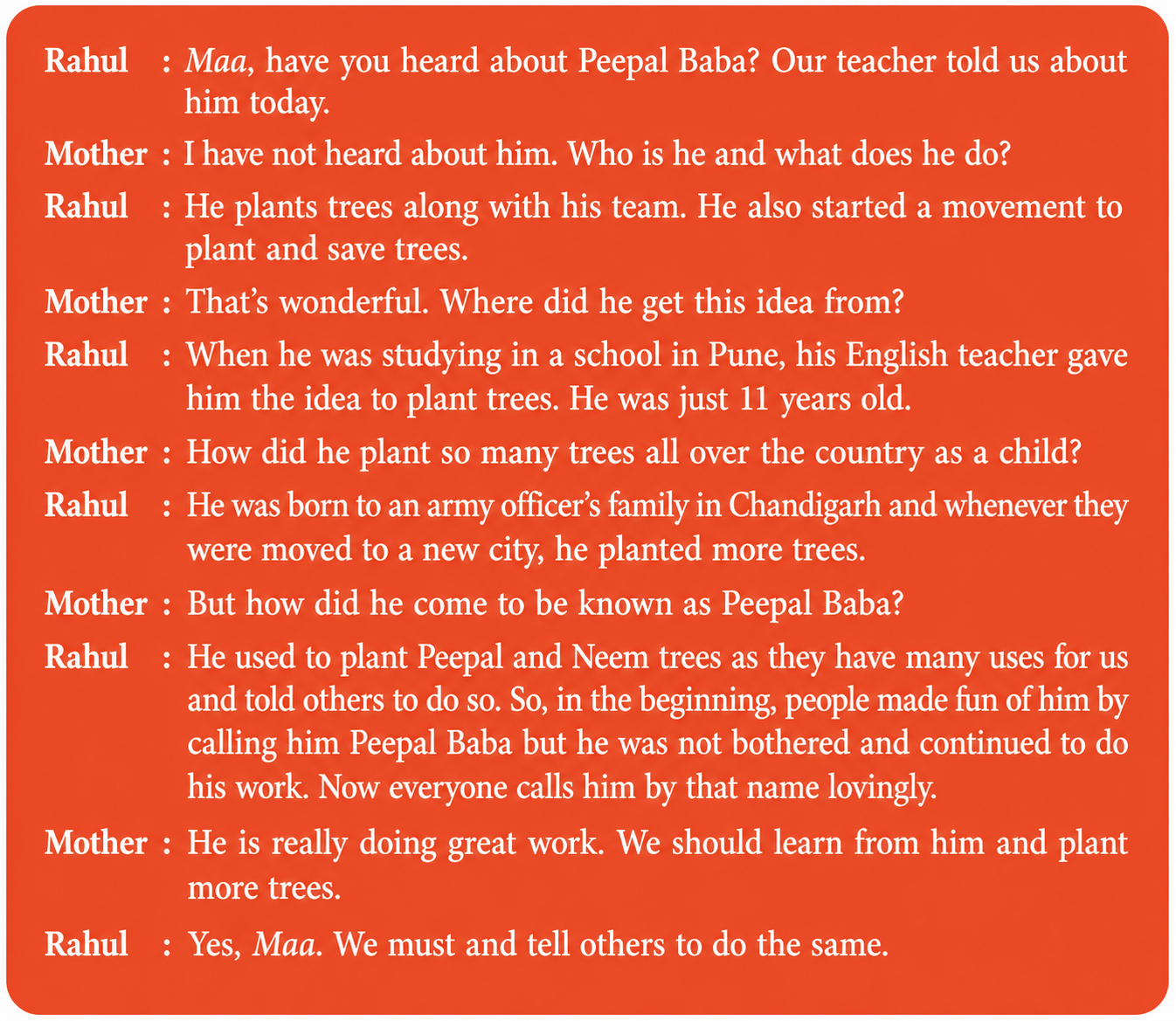
(b) The mother disliked the work being done by Peepal Baba.
(c) The mother wanted to know more about Peepal Baba.
(d) The boy decided to take care of trees by listening to Peepal Baba’s journey.
(e) The boy was worried about what his teacher had told him.
ANS: (a), (c), and (d) are correct statements.
🗣️ 9. Let Us Speak
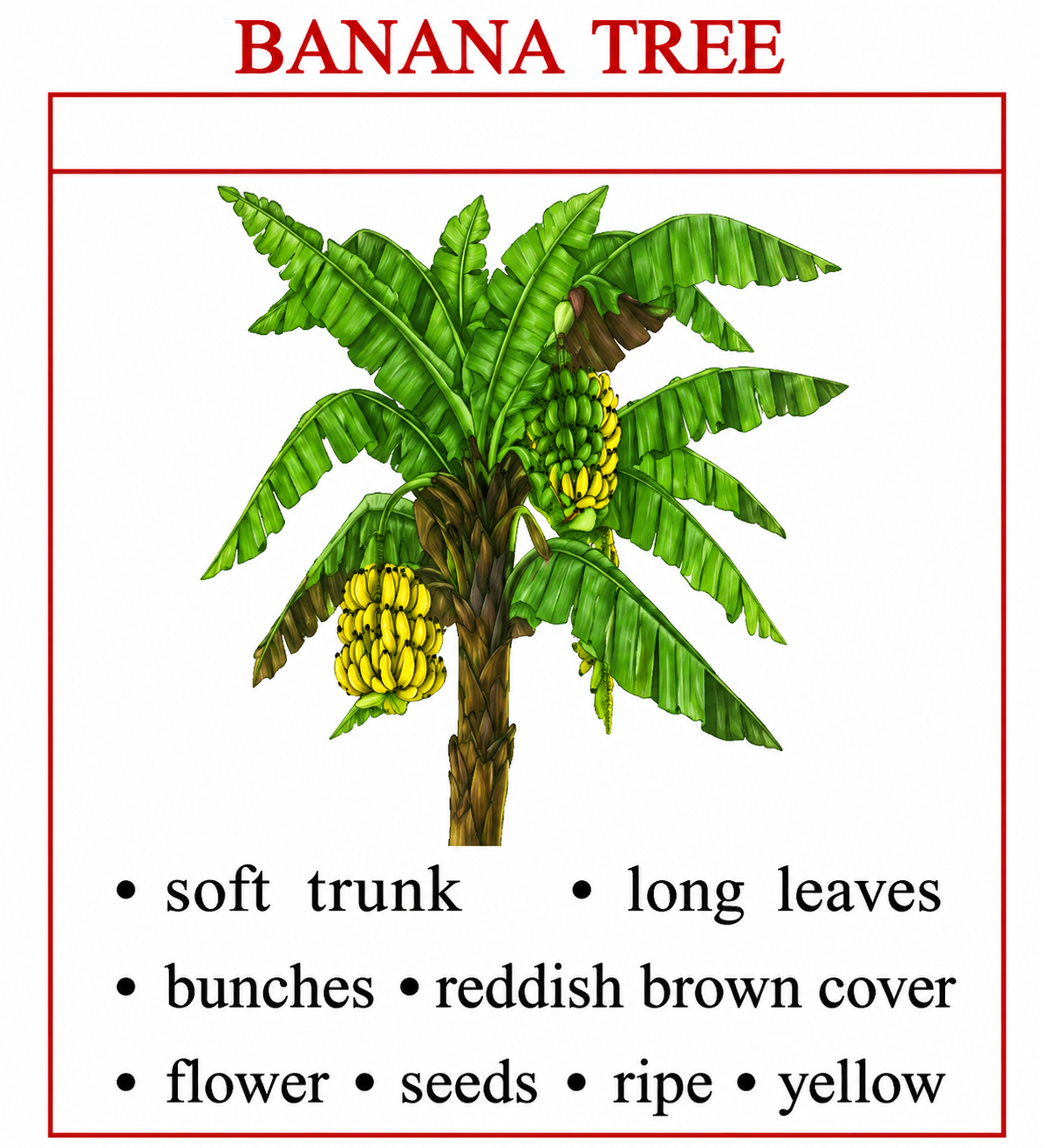
2. I have soft trunk and long leaves.
3. My flowers grow in bunches inside a reddish brown cover.
4. My fruits also grow in large bunches and are without seeds.
5. Children like ripe yellow bananas very much.
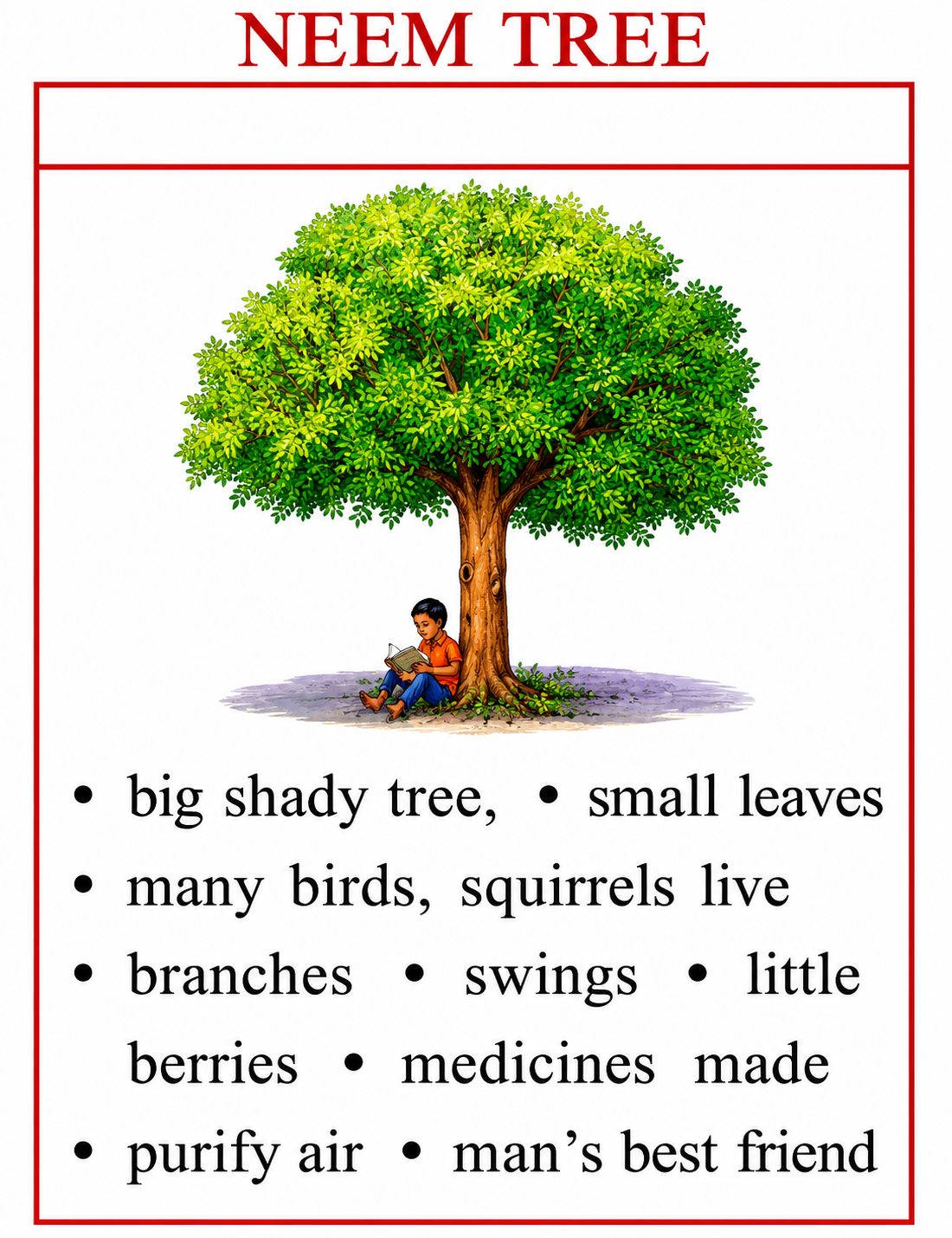
1. I am a neem tree.
2. I have strong branches and green leaves.
3. My leaves and bark have medicinal properties.
4. Birds rest on my branches and people enjoy my cool shade.
5. I help in keeping the environment clean and healthy.
✍️ 10. Let Us Write
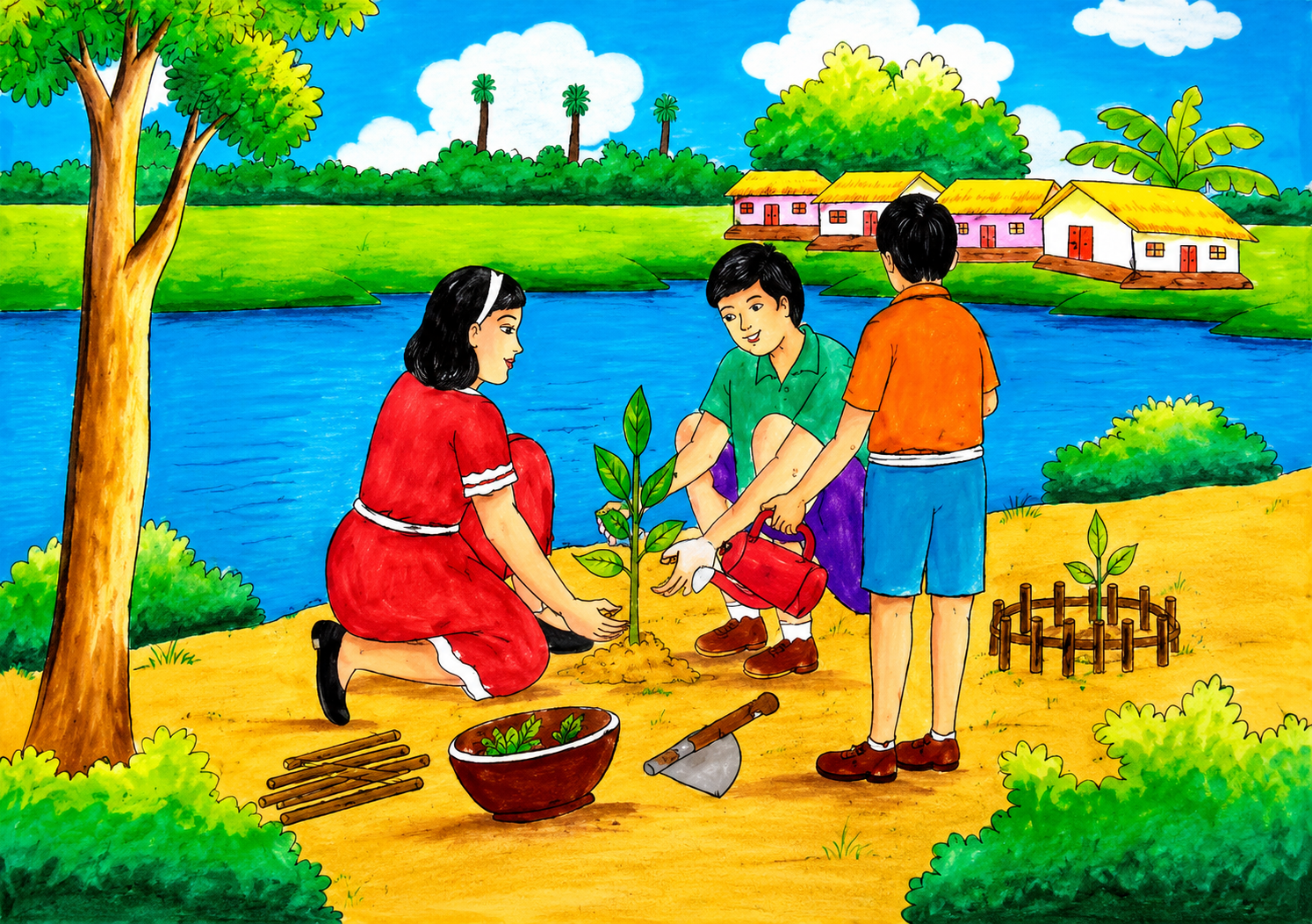
2. Collect suitable soil.
3. Place a plant guard and take care till it stands upright.
4. Prepare the seed.
5. Find out a proper place for planting the sapling.
6. Plant the seed in the pot.
7. Dig a pit, add manure, and plant the sapling.
8. Place the pot in a place where it can get enough sunlight.
2. Collect suitable soil.
3. Plant the seed in the pot.
4. Place the pot in a place where it can get enough sunlight.
5. Water the plant regularly.
6. Find out a proper place for planting the sapling.
7. Dig a pit, add manure, and plant the sapling.
8. Place a plant guard and take care till it stands upright.
🌍 11. Let Us Explore
I have no .........
My leaves are large.
My young fruit is green, with ........seeds and it’s eaten as a vegetable.
My grown up fruit is sweet and yellow with ....... seeds and its eaten as a fruit.
I am a papaya tree.
( Hints : branches, black, trunk, white)
My trunk is straight.
I have no branches.
My leaves are large.
My young fruit is green, with white seeds and it’s eaten as a vegetable.
My grown up fruit is sweet and yellow with black seeds and its eaten as a fruit.
I give cool shade to people.
Birds make nests on my branches.
My fruits are sweet and juicy.
Children love to eat them in summer.
Who am I?
ANS: Mango Tree
Students should collect leaves from nearby plants or trees such as neem, mango, guava, banyan, or tulsi. They can show the leaves to their classmates and ask them to identify the name of the plant or tree by observing the shape, size, colour, and texture of the leaves.
✅ 12. Conclusion
The lesson Women for Trees teaches us the importance of protecting forests and conserving nature through community participation. The women of Bhalapur showed courage, unity, and determination by transforming barren land into a green forest. Their efforts prove that ordinary people can bring extraordinary changes when they work together for the environment. The lesson inspires us to plant more trees, protect forests, and become responsible citizens for a greener and healthier future.
❓ 13. FAQ Section
1. What is the main theme of the lesson Women for Trees?
The lesson focuses on protecting forests and the role of women in environmental conservation.
2. Where is Bhalapur village located?
Bhalapur village is located in Chhattisgarh.
3. Why did the women form a Mahila Mandal?
The women formed a Mahila Mandal to solve the problem of firewood shortage and protect forests.
4. What problem did Bhalapur face in the 1980s?
Bhalapur faced severe deforestation and shortage of firewood.
5. How much land was regenerated by the women?
The women regenerated 12 hectares of barren land.
6. What did the women do to protect the forest?
They dug trenches and guarded the forest from animals, poachers, and the timber mafia.
7. What does the word biodiversity mean?
Biodiversity means a variety of living plants, animals, and organisms in one area.
8. Why are forests important?
Forests provide oxygen, rainfall, medicines, wood, and shelter for animals.
9. What lesson do we learn from the women of Bhalapur?
We learn the importance of unity, hard work, and environmental protection.
10. What is a timber mafia?
A timber mafia is a group involved in illegal cutting and selling of trees.
11. What are the benefits of planting trees?
Planting trees helps in reducing pollution and maintaining ecological balance.
12. What kind of forest stands in Bhalapur today?
A dense and biodiverse forest stands in Bhalapur today.
13. How can students help protect nature?
Students can plant trees, save water, and spread awareness about environmental conservation.
14. Why should we protect trees?
Trees are necessary for clean air, rain, and the survival of all living beings.
15. What message does the lesson give to society?
The lesson gives the message that people together can protect forests and create a greener future.
🔗 14. Related Lessons
- A Bottle of Dew
- The Tree That Never Stopped Giving
- The Raven and the Fox